Image by: Knelstrom Media
Back to school, then someone deployed the bouncy castles.
By Martin Foskett, Reporter
PUBLISHED:
UPDATED:
Wednesday morning arrived in Elsenham with the unmistakable atmosphere of a population being returned to government supervision. From around 08:00, after six weeks of bicycles, footballs, late breakfasts, unexplained shouting and children appearing from hedges carrying sticks of uncertain strategic value, the school run began. Pavements filled with new shoes, oversized jumpers, immaculate book bags and parents attempting to remember how mornings worked. Somebody had forgotten a water bottle. Another family was conducting an emergency search for a PE kit last seen somewhere around July, while cars began performing the familiar low-speed choreography of September as adults rediscovered that leaving the house at roughly the same time as everyone else has consequences.
The Siege had entered its autumn phase, although it must be recorded that the summer campaign ended with one extraordinary outbreak of competence from Essex Highways.
During the holidays, they sent Dave.
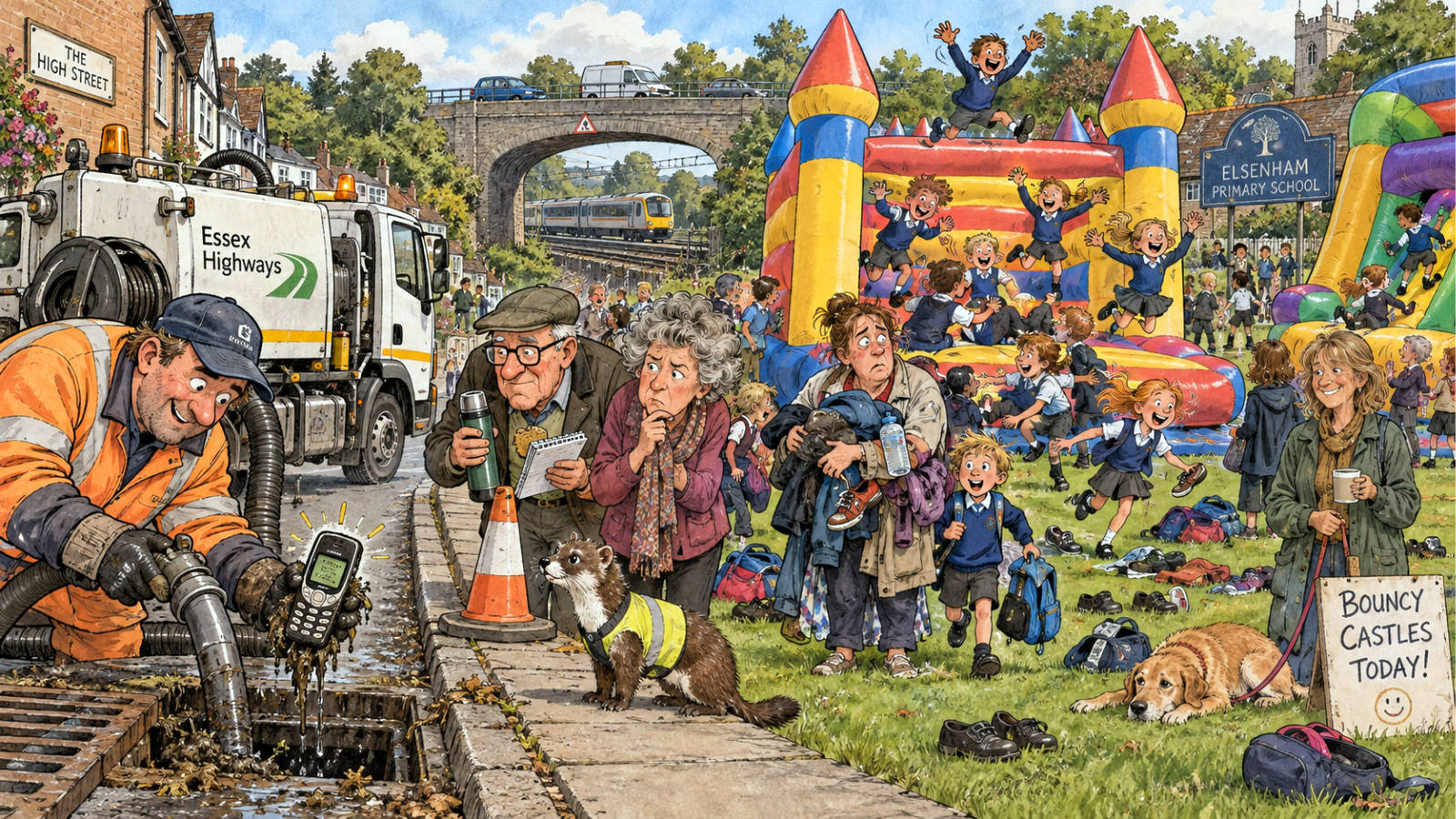
Dave arrived on the High Street in his gully-emptying truck and, without forming a steering committee, publishing a consultation or surrounding the entire village with enough cones to be visible from Stansted Airport, proceeded to clean out the drains.
All of them.
For several days he worked his way along the High Street, lifting years of leaves, silt, gravel and miscellaneous Essex sediment from gullies that had apparently been operating primarily as underground compost bins. The truck growled. Hoses disappeared into drains. Unspeakable material came back out. Dave continued with the expression of a man for whom this was simply Tuesday.
Then they found the Nokia.
Nobody knows which model it was. Nobody knows who owned it. More importantly, nobody knows how long it had been in the drain.
It emerged from the subterranean mulch looking like an archaeological exhibit from the early years of mobile telecommunications, coated in the accumulated sediment of Elsenham and apparently having spent an unspecified period sharing accommodation with leaves, rainwater, road grit and whatever else disappears through a High Street gully.
Someone pressed a button.
The screen came on.
There were 18 missed calls.
Battery level: 50 per cent.
Work stopped.
Even Dave looked at it.
This was no longer drainage maintenance. Archaeology had collided with telecommunications.
Barry arrived from the direction of Tesco and demanded that nobody touch anything until he had documented the battery reading. Margaret immediately suggested the phone might predate at least three sets of roadworks. Colin the Ferret appeared from beneath a parked car and regarded it with professional irritation, presumably because somebody had installed a communications device underground without notifying Central Operations Command.
Nobody attempted to return the missed calls.
There are limits.
They took the Nokia away for examination, or possibly just wiped it with a cloth. Reports remain unclear. What is clear is that it survived an unknown period in an Elsenham drain, still had half its battery, and had received 18 calls from somebody who, by this stage, really ought to have taken the hint.
Dave returned to work.
For villagers accustomed to infrastructure projects developing their own mythology before anybody picks up a shovel, this was deeply unsettling.
Barry established an observation post near Tesco with a packet of Bourbons and announced that drainage capacity was now “moving in the right direction”. Margaret appeared twenty minutes later and claimed the blocked gullies had been connected to everything from rainfall patterns to the state of the roads and a wheelie bin incident she had witnessed in 2009. Colin watched from beneath a parked car with narrowed eyes, visibly offended that someone had entered the subterranean theatre without first consulting Tunnel Command.
But Dave carried on.
And then something remarkable happened.
It rained.
The water disappeared.
People stared.
A man near the Post Office actually stopped walking.
At the railway bridge, the transformation was particularly profound. The road crosses over the railway there, but during sufficiently enthusiastic Essex rainfall the approaches had developed an aquatic character absent from the original engineering brief. For years the structure had maintained an uneasy dual identity. In dry weather it was a bridge carrying traffic over the railway. After sustained rain, it began identifying as an aqueduct, with motorists approaching the accumulated water while quietly calculating the wading depth of a Ford Focus.
Not anymore.
As a direct result of Dave’s fine work, the railway bridge no longer identifies as an aqueduct.
Water now reaches the drains and, in a development that has stunned Central Operations Command, goes into them.
Joe, reporting calmly from the railway front below, confirmed that water was leaving the road rather than attempting to join the rail network.
“Seems to be working,” he said.
This was the strongest official endorsement available.
Central Operations Command briefly discussed awarding Dave the Order of the Gully. However, the proposal collapsed when Sheila asked whether medals required a separate agenda item and Margaret suggested a commemorative drainage cake showing the High Street in blue icing.
By then Dave had already moved on.
No ceremony. No commemorative plaque. No eighteen-month pilot scheme.
He had emptied the drains, recovered a Nokia apparently capable of surviving the collapse of Western civilisation, and left.
The village was not emotionally prepared for this level of efficiency.
Against this dangerous backdrop of functioning infrastructure, the children returned to school.
This mattered because they had spent the summer functioning as Elsenham’s unofficial reconnaissance network, an enormous, loosely coordinated intelligence service with scooters. They knew where the cones were, which road had suddenly acquired temporary lights, where the suspicious van had parked and whether Colin the Ferret had been seen near the Rec wearing his tiny high-vis vest. Now, almost overnight, that capability had vanished behind classroom doors and shifted to handwriting.
Central Operations Command regarded the development with concern.
Will N. Power convened an emergency meeting over tea and announced that the village had suffered an immediate reduction in street-level surveillance capacity. Barry, who had already constructed a situation map using three packets of biscuits and the back of a Tesco receipt, estimated the intelligence loss at 63 per cent. However, nobody could establish where the figure came from.
“It’s significant,” he said, moving a Bourbon towards the school on the map.
Margaret stared at it.
“What does that represent?”
“Year Four.”
Nobody asked anything further.
Outside, the village had become eerily adult. Tesco was navigable again. The sweet aisle no longer resembled the aftermath of a minor sporting event. Scooters were no longer lying diagonally across pavements like abandoned military hardware, and somewhere near the Post Office a pensioner completed an entire conversation without being interrupted by a football.
Mark Price at Tesco described the situation as “fully under control”, which in Elsenham is traditionally regarded as an invitation for events to deteriorate.
Barry had taken up position near the biscuits anyway.
He had prepared for back-to-school week with the seriousness normally associated with an Antarctic expedition. Emergency custard creams occupied one pocket. A cereal bar reserve occupied another. His flask had been filled before dawn and labelled PRIMARY SUPPLY, while a second flask sat in his bag under the designation CONTINGENCY TEA.
“You can’t assume Wednesday will behave like Thursday,” he explained.
This was technically true.
By Thursday the first-week polish had begun to wear off. New shoes had acquired mud. Shirts were coming home with substances on them that parents were advised not to investigate too closely. Lunchboxes returned containing exactly one warm cucumber slice and absolutely none of the food anybody remembered packing.
Sara’s dogs watched the school run from behind her gate with the quiet professionalism of animals who could immediately see where humanity had gone wrong. One sat down. The other observed a parent carrying two bags, three coats, a scooter and what appeared to be a papier-mâché volcano.
Sara nodded towards the dog.
“He wouldn’t organise it like that.”
Nobody doubted her.
Colin, meanwhile, had taken the return to school personally.
He appeared near the railings on Thursday afternoon in full high-vis, inspecting the flow of parents with the severe expression of a transport commissioner who had discovered somebody had moved a bollard without completing the correct form. He examined a discarded crisp packet, inspected one of Dave’s newly cleared drains, then spent several minutes staring at a traffic cone as though the pair had unfinished business dating back to spring.
The cone remained silent.
Colin did not.
Witnesses reported a low series of irritated squeaks before he disappeared beneath a hedge in the general direction of Tunnel Dick.
Underground, operations continued. Tom remained notionally aimed towards Stansted. Dick was still committed to Takeley, although commitment and geographical progress had long ceased to mean the same thing beneath Elsenham. Harry continued towards Henham under conditions nobody was prepared to describe as encouraging.
Ben Dover of the Bureau of Operational Route Excavation denied that any of the tunnels existed while standing beside a wheelbarrow full of freshly excavated soil.
“Routine gardening,” he said.
There was no garden.
Friday morning therefore began under apparently stable conditions. Children went into school. Parents dispersed. Joe at the station crossing reported nothing beyond the ordinary choreography of trains, barriers and motorists suddenly remembering they had somewhere desperately important to be.
Then intelligence arrived.
There were going to be bouncy castles.
After school.
On the field.
On a Friday.
The news moved through Elsenham with astonishing speed. By lunchtime, Margaret had added it to the conspiracy wall between a photograph of a wheelie bin and a handwritten note concerning rainfall. Barry received confirmation near the Tesco Meal Deal section and immediately abandoned a perfectly serviceable chicken sandwich.
“Inflatables?” he said.
The word hung there.
A woman choosing crisps looked up.
“Apparently.”
Barry reached for his phone.
Within eleven minutes, Central Operations Command had been informed that the school intended to combine several hundred children, the emotional release of completing the first week back, Friday afternoon, and large structures specifically designed to encourage uncontrolled bouncing.
The COC upgraded the situation from Routine Educational Activity to Significant Vertical Movement.
There was no official scale. Will had invented it while making tea.
At approximately 3 pm, the first inflatable forms became visible.
They rose behind the school like brightly coloured temporary government installations, great swollen monuments to the national belief that children who had spent three days being told to sit down should immediately be given an enormous rubber structure upon which sitting down was virtually impossible.
Parents arriving at the gates slowed.
Children saw them.
And civilisation altered course.
The bell went.
What followed was not technically a charge, but future historians may struggle with the distinction.
Children emerged carrying bags, jumpers, water bottles and three days of accumulated classroom restraint. They spotted the bouncy castles and accelerated. Parents attempted to maintain formation but were rapidly overwhelmed by small people removing shoes while still moving.
Within minutes the field had become an inflatable theatre of operations.
Children flew upwards and vanished behind battlements. Socks accumulated in drifts. Shoes formed unregulated settlements around the perimeter. One parent stood holding four coats and staring into the middle distance with the expression of somebody whose original weekend plans had ceased to have legal standing.
Barry arrived carrying his tactical flask.
Nobody had invited him in an operational capacity.
This did not affect him.
He positioned himself where he could monitor both the inflatables and refreshments, explaining that energy expenditure required a corresponding biscuit strategy. He had produced a small notebook containing calculations.
“Bounce rate is high,” he said gravely.
“How high?”
“Very.”
It was difficult to dispute.
Margaret arrived shortly afterwards and immediately connected the entire event to the weather.
“Ground’s been waiting for this,” she announced.
Nobody knew what that meant, including Margaret, but she said it with sufficient authority that two people looked down.
Sara appeared with one of her dogs, who observed the bouncy castles for several seconds, assessed the screaming, the bouncing and the adults trying to locate missing footwear, then lay down facing the opposite direction.
Again, the animals were ahead of us.
Joe, passing intelligence from the railway front with his usual calm, reported that the noise could probably be heard from the station.
“No disruption to services,” he added.
This was the first sensible sentence anybody had spoken for forty minutes.
Then Colin arrived.
Nobody saw where he came from.
One moment there was grass. The next, a ferret in high-vis stood near the edge of an inflatable obstacle course, staring at it with the profound suspicion of a creature who had spent months dealing with tunnels, cones, and municipal infrastructure, only to discover humans had now started constructing buildings out of air.
He approached cautiously.
The castle shifted.
Colin froze.
A child landed on the other side, and the entire structure trembled.
Colin backed away.
For perhaps the first time in Siege history, infrastructure had intimidated the Ferret.
This lasted six seconds.
He advanced again, nose down, conducting what appeared to be an inspection of the anchoring arrangements. Barry watched him closely.
“He’s checking the perimeter.”
“He’s a ferret.”
“Exactly.”
By half past four, the first-week exhaustion had collided completely with Friday hysteria. Children who had spent Wednesday looking immaculate now resembled survivors of an unusually cheerful shipwreck. Hair stood vertically. Faces were red. Jumpers had vanished into the textile economy. Parents circulated holding shoes that did not belong to their children.
Central Operations Command quietly revised its assessment.
Will N. Power described the scene as “fluid”.
This was generous.
The Parish Council ensemble had also begun to gather at a safe distance. Gordon wore his traffic-cone cravat. Sheila had somehow brought a binder. Nobody knew what documentation she expected to require at a bouncy castle, but experience had taught Elsenham never to underestimate Sheila’s ability to locate paperwork in a recreational environment.
A discussion began concerning whether inflatables constituted temporary structures.
It lasted long enough for several children to complete primary education.
Nearby, Barry was now discussing snack replenishment rates with the solemnity of a NATO quartermaster. Margaret claimed the unusual concentration of abandoned footwear was “exactly how these things start”. Sara’s dog remained motionless and, by default, became the most senior figure present.
The afternoon finally ran out of energy. Children came down from the castles one by one, glowing with that peculiar combination of triumph and complete physical collapse. Parents reconstructed families from scattered possessions. Shoes were matched with feet. Bottles were recovered. A jumper changed hands three times before finding its owner.
The great inflatables still towered above the field, gently moving in the Essex air as if breathing after battle.
Colin sat nearby.
His inspection was complete.
He appeared unconvinced.
As families drifted home, the village settled into the exhausted quiet of Friday evening. Tesco received the returning population in waves. Barry conducted a final resupply. Margaret went home to update the wall. Sara’s animals resumed whatever competent parallel administration they had clearly been running without us.
Below ground, Tom, Dick and Harry continued their uncertain journeys beneath Essex.
At the crossing, Joe watched another train pass and reported no wider consequences for the rail network.
And behind the school, the bouncy castles slowly came down.
Something was fitting about it. On Wednesday, Elsenham had handed its children back to order, routine, timetables, registers and classrooms. Forty-eight hours later, the school itself had apparently reconsidered the arrangement and erected enormous inflatable structures so everybody could finish the week by launching themselves repeatedly into the air.
That may be education.
It may be community resilience.
Perhaps somebody knew exactly what children needed after their first three days back.
Whatever the explanation, by Friday evening the opening week of term had already entered village folklore. The uniforms had survived. Most of the shoes had been recovered. The school was still standing. Colin had encountered inflatable infrastructure and lived to distrust it. Dave had cleaned the drains. The railway bridge had stopped identifying as an aqueduct. And somewhere there exists a Nokia with 18 missed calls, 50 per cent battery and absolutely no intention of explaining where it has been.
The Siege continues, but for one Friday afternoon the front line was made of vinyl, the casualties were mainly missing socks, and Elsenham discovered that after months of cones, tunnels, diversions and administrative warfare, sometimes the most effective piece of village infrastructure is simply a very large castle filled with air.
End of Transmission.
#elsenham #essexhighways #elsenhamherald
Support the Elsenham Herald
The Herald is independently published and free for everyone to read. If you’d like to help, please consider liking, sharing, and commenting on our articles; recommending us to friends and neighbours; or submitting local news, events, and photographs. You can also support our work financially. Every action, no matter how small, helps us continue providing accurate, fair and transparent local journalism for Elsenham and the surrounding villages.
Learn more at our Support the Herald Page.

Author: Martin Foskett
me