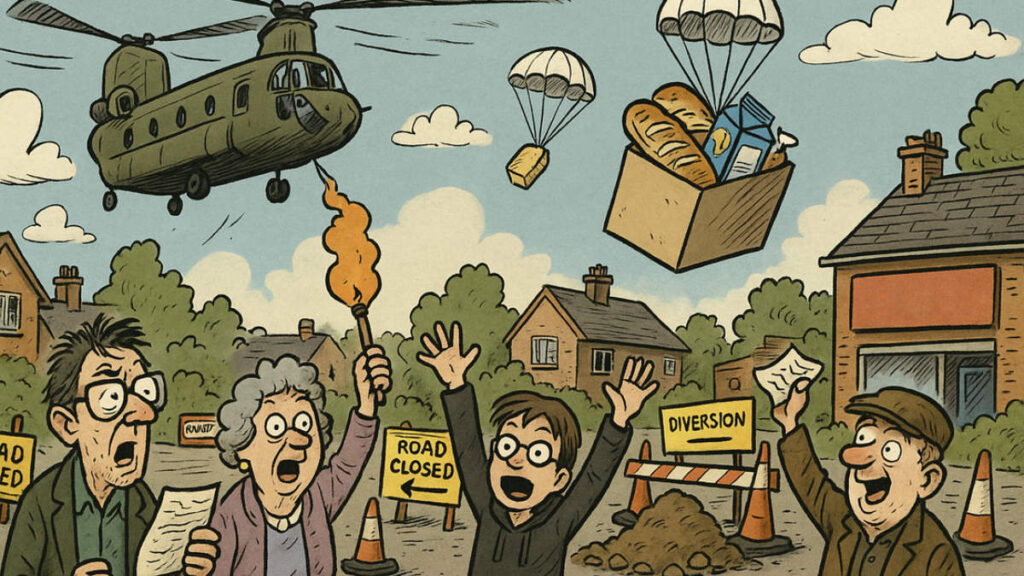

Image by: Knelstrom Media
July update: Heat, headlines and the dust that conquered Elsenham
By Martin Foskett, Reporter
PUBLISHED:
UPDATED:
July has settled over Elsenham with all the restraint of a patio heater pointed directly at the village. Day after day, the same enormous orange sun has sat overhead, refusing to budge. At the same time, gardens that only a few weeks ago looked like postcards from the English countryside have quietly surrendered. Lawns have turned the colour of old cereal, flower beds are conducting a daily battle for survival, and every conversation now begins with someone saying, “It’s not the heat. It’s the lack of rain,” before immediately agreeing that actually it is both.
The arrival of the hosepipe ban has done little to improve morale. Buckets have become fashionable once more, watering cans are suddenly prized possessions, and residents now inspect dark clouds with the enthusiasm of people waiting for long-lost relatives. The allotments have become particularly tense. Mick Sturbes, Head of Plot 14 and a man who normally measures life in cabbage yields, misunderstood the announcement with remarkable efficiency.
Convinced that a hosepipe ban meant hosepipes themselves were about to become unavailable, Mick embarked upon what can only be described as Operation Flexible Rubber. Hardware stores across the district watched in amazement as he systematically emptied their shelves, loading coils of hosepipe into his car until the rear suspension resembled a collapsed deckchair.
The misunderstanding finally came to an end when a shop assistant gently explained that the hosepipes were not banned from existence. People were not allowed to use them for most domestic watering.
Witnesses describe Mick staring into the middle distance before quietly asking whether three hundred metres of reinforced garden hose qualified as an impulse purchase.
Central Operations Command later concluded that while the operation had failed strategically, it demonstrated “excellent procurement discipline under uncertain circumstances.” Barry suggested the spare hosepipe could be repurposed as emergency tunnel ventilation.
Speaking of tunnels, work beneath the village continues despite conditions above ground becoming increasingly unforgiving. Tom remains the most productive route, steadily advancing beneath increasingly stubborn soil towards Stansted. Digging crews report that every shovel now raises a cloud of fine dust before striking earth that has the consistency of Victorian brickwork. Dick continues making slow but determined progress towards Takeley after Colin the Ferret condemned one section as “operationally disrespectful” and ordered additional support using reclaimed biscuit tins. Harry remains the most adventurous of the three, edging towards Henham while periodically encountering roots, flint and what Barry insists is “hostile geology.”
Colin himself appears largely unaffected by the heat. Wearing his now familiar miniature high visibility vest, he has introduced compulsory hydration breaks despite possessing neither authority nor engineering qualifications. Nobody has objected.
Above ground, another operation briefly eclipsed every other story in the village.
The airport parking site beyond the M11 towards Stansted continues operating. At the same time, its appeal process works its way through the planning system, and with local concerns continuing about its impact on the surrounding area, the BBC arrived to report on the story.
A camera crew, reporter and production team set up beside the site early in the morning, preparing interviews about the ongoing dispute and its effect on nearby residents. For a few glorious minutes the entire exercise remained a perfectly ordinary piece of journalism.
Then somebody spotted the BBC van.
News travelled across Elsenham with extraordinary efficiency.
“The BBC are here.”
Nothing else mattered.
By the time filming began, the surrounding area had quietly acquired an audience of villagers who all insisted they happened to be passing. Some arrived carrying shopping they had no obvious need for. Others appeared to have developed a sudden fascination with hedgerows, road signs and bus stops positioned directly behind the television camera.
Barry was among the first to arrive, wandering casually through the background with a reusable shopping bag containing what appeared to be little more than biscuits. Having completed one pass, he disappeared before returning from the opposite direction several minutes later, now carrying a newspaper for what he later described as “continuity.”
Margaret took up position near a hedge with a watering can, apparently forgetting that the hosepipe ban had not made watering dead shrubs with theatrical determination any more convincing. She spent several minutes inspecting leaves with such concentration that the producer briefly assumed she was part of the interview.
Sara’s dogs displayed considerably greater professionalism than most of the assembled spectators. They sat quietly beside the footpath, entirely content to watch events unfold. At the same time, Sara repeatedly apologised for them being “a bit curious,” despite the dogs remaining among the calmest individuals present.
Joe happened to be nearby and was genuinely invited to speak. In measured tones, he explained how local traffic patterns had changed and how residents had adapted to increasing activity around the area. It was concise, informative and exactly the sort of contribution the BBC had come to record.
Naturally, it received the least discussion afterwards.
The true star of the morning arrived from beneath a nearby hedge.
Colin the Ferret emerged wearing his tiny high visibility vest and carrying half a Rich Tea biscuit with complete confidence. Without hesitation he marched towards the camera, paused directly beneath the lens and stared into it with the calm expression of a seasoned foreign correspondent covering international affairs.
The reporter carried on admirably.
Barry walked through the background again.
Somewhere behind the camera somebody could clearly be heard whispering, “That’s the ferret.”
By lunchtime the original story had almost disappeared beneath village folklore.
Tesco became an unofficial media analysis centre. Customers abandoned discussions about meal deals in favour of replaying the broadcast on their phones. Half the village insisted they had narrowly missed appearing on national television. Several maintained they had deliberately avoided the cameras because they “didn’t want the attention.”
Barry has since reviewed the footage repeatedly and remains convinced that his left shoulder received almost two seconds of uninterrupted airtime.
Elsewhere, contractors have continued work on the Robin Hood Road development. Following months of clearance work that briefly exposed the site, it has now vanished once again, not behind trees or fencing but beneath enormous clouds of pale dust that drift lazily across the surrounding roads whenever the wind decides to participate.
Residents have abandoned washing their cars before weekends because experience has shown the effort survives for approximately twenty minutes. Vehicles now wear such a consistent layer of dust that newcomers have begun asking whether Elsenham recently hosted an international rally stage.
Margaret reports dusting the house three times a day while remaining permanently one afternoon behind.
Sara says even the dogs now return from walks looking as though they have spent the morning excavating Roman villas.
Central Operations Command briefly debated whether the dust qualified as its own weather system before deciding further monitoring was required.
Despite the relentless heat, village life continues with its usual determination. Chris P. Batter at the fish bar reports that demand for chips remains reassuringly constant because, in his words, “Roadworks, sunshine and television crews don’t stop people wanting chips.” Diane Perm observes that hairstyles currently survive only slightly longer than ice creams left on a garden table. Mark Price calmly assures customers that bottled water supplies remain stable despite periodic waves of enthusiastic stockpiling whenever the forecast contains the word “sunny.”
The month concluded with a reminder that summer also brings genuine emergencies. Fire crews were called to You’re Furnished in Molehill Green following reports of a refuse lorry fire. The Elsenham Herald understands the cause has been confirmed as a lithium battery within the waste. The incident serves as an important reminder that batteries should always be disposed of through the correct recycling routes rather than placed in general rubbish, where they can become damaged and ignite.
As another hot July evening settles across the village, the grass remains brown, the tunnels continue inching beneath our feet, dust hangs gently over Robin Hood Road, and somewhere in Elsenham Mick Sturbes is still wondering what practical use can be found for enough hosepipe to irrigate a small principality. The BBC has packed away its cameras, the headlines have moved elsewhere, and the village has quietly resumed its familiar rhythm, carrying on exactly as it always does, somewhere between practical resilience and cheerful absurdity.
Support the Elsenham Herald
The Herald is independently published and free for everyone to read. If you’d like to help, please consider liking, sharing and commenting on our articles, recommending us to friends and neighbours, or submitting local news, events and photographs. You can also support our work financially. Every action, no matter how small, helps us continue providing accurate, fair and transparent local journalism for Elsenham and the surrounding villages.
Learn more at our Support the Herald Page.

Author: Martin Foskett
me