Image by: Knelstrom Media / Alamy
Decorative Straw Finials. Centuries of Craftsmanship Crowned in Straw
By Martin Foskett, Reporter
PUBLISHED:
UPDATED:
Decorative Straw Finials. Centuries of Craftsmanship Crowned in Straw
Look up at an old thatched cottage, and there is every chance the finest piece of craftsmanship is not the roof itself, but the small ornament standing proudly along its ridge.
To many people, a decorative straw finial is simply an attractive finishing touch. A flourish of woven straw that gives a cottage its postcard charm. Yet these remarkable creations represent one of Britain’s oldest surviving traditions of vernacular art. They are the meeting point of architecture, agriculture, folklore, and individual craftsmanship, preserving customs that have evolved over many hundreds of years.
Whether formed into birds, hearts, crosses, dragons, owls, pheasants, horses, or the famous pair of boxing hares, every finial tells a story.
The Origins of Straw Craft
Long before decorative finials adorned rooftops, straw itself was one of humanity’s most valuable building materials.
Archaeological evidence shows that people across Europe had been using reeds, grasses, and cereal straw to roof buildings for thousands of years. In Britain, thatching was already well established during the Iron Age and remained the most common roofing material throughout the Roman, Anglo-Saxon, and medieval periods.
Every autumn, after the grain harvest, farmers were left with vast quantities of straw. Nothing was wasted. Straw was used for bedding for livestock, insulation, basketry, rope, hats, floor coverings, and roofing.
Alongside these practical uses developed an extraordinary tradition of decorative straw weaving.
Across Britain and northern Europe, the final sheaf of harvested grain often received special treatment. Rural communities believed the crop’s life force remained within the last standing corn. This belief, known today through traditions surrounding the Corn Spirit or Corn Mother, inspired the creation of woven harvest ornaments, commonly called corn dollies.
Although modern historians debate how widespread or ancient these beliefs truly were, there is little doubt that harvest customs celebrating abundance, fertility, and gratitude formed an important part of rural life for centuries.
The ability to weave straw into intricate shapes became a respected rural craft.
The Evolution of Decorative Ridge Work
The roof ridge is the most exposed part of any thatched building. It is also where two slopes meet, requiring careful weatherproofing.
By the late medieval period, experienced thatchers had begun treating the ridge as more than a functional necessity. Decorative patterns appeared within the ridge itself, initially as geometric designs formed by careful cutting and stitching.
As techniques improved, ornamental ridge work became increasingly elaborate.
Rather than simply protecting the roof, master thatchers began to display their skill by adding decorative woven finials secured to the ridge.
These ornaments varied enormously from county to county.
Some regions preferred simple crosses or diamonds.
Others favoured birds, wheat sheaves, wheels, knots, spirals, or heraldic motifs.
The finial became both a signature and a celebration of craftsmanship.
A Tradition Passed Through Generations
Unlike many traditional building trades, thatching has always relied upon apprenticeship.
Knowledge was rarely written down.
Young apprentices learned by watching experienced craftsmen. They discovered how to prepare long straw, combed wheat reed, or water reed. They learned the importance of moisture, tension, balance, and weather resistance.
Decorative finials represented the highest expression of these skills.
Creating a successful final required far more than artistic ability. Every woven strand had to survive years of wind, rain, frost, and summer heat while remaining securely fixed to the roof.
Many master thatchers became recognised by their distinctive ornamental styles.
In some villages, neighbouring roofs displayed subtly different finials because each reflected the preferences and techniques of a different craftsman.
No two were ever completely identical.
Symbols Above the Home
Decorative finials often carried symbolic meaning.
A cross expressed Christian faith and divine protection.
A heart represented love, hospitality, and family.
Doves symbolised peace.
Pheasants reflected the surrounding countryside.
Wheat sheaves celebrated abundance.
Owls suggested wisdom and vigilance.
Some designs were chosen simply because they demonstrated technical excellence.
Others reflected the owner’s interests, local wildlife, or village traditions.
The beauty of the tradition lies in its flexibility. There has never been a single national pattern. Every region developed its own character, and every master thatcher left something of themselves in the finished work.
Decline and Revival
During the nineteenth century, Britain’s roofing industry changed dramatically.
Industrialisation brought cheaper roofing materials such as slate, clay tiles, and later concrete tiles. Thatched roofs steadily disappeared from towns and many villages.
As demand declined, so too did the number of skilled thatchers capable of producing decorative ridge work.
By the middle of the twentieth century, many feared the craft might disappear altogether.
Fortunately, the conservation movement transformed attitudes towards historic buildings. Organisations dedicated to preserving Britain’s architectural heritage recognised that traditional thatching represented far more than a roofing technique. It embodied centuries of accumulated knowledge and regional identity.
Apprenticeships expanded. Historic cottages were restored. Decorative finials once again became an important feature of newly thatched roofs.
Today, they remain among the most distinctive forms of British folk art, still created entirely by hand.
The Meaning Behind the Two Boxing Hares
Among all decorative straw finials, none has captured the public imagination quite like the two boxing hares.
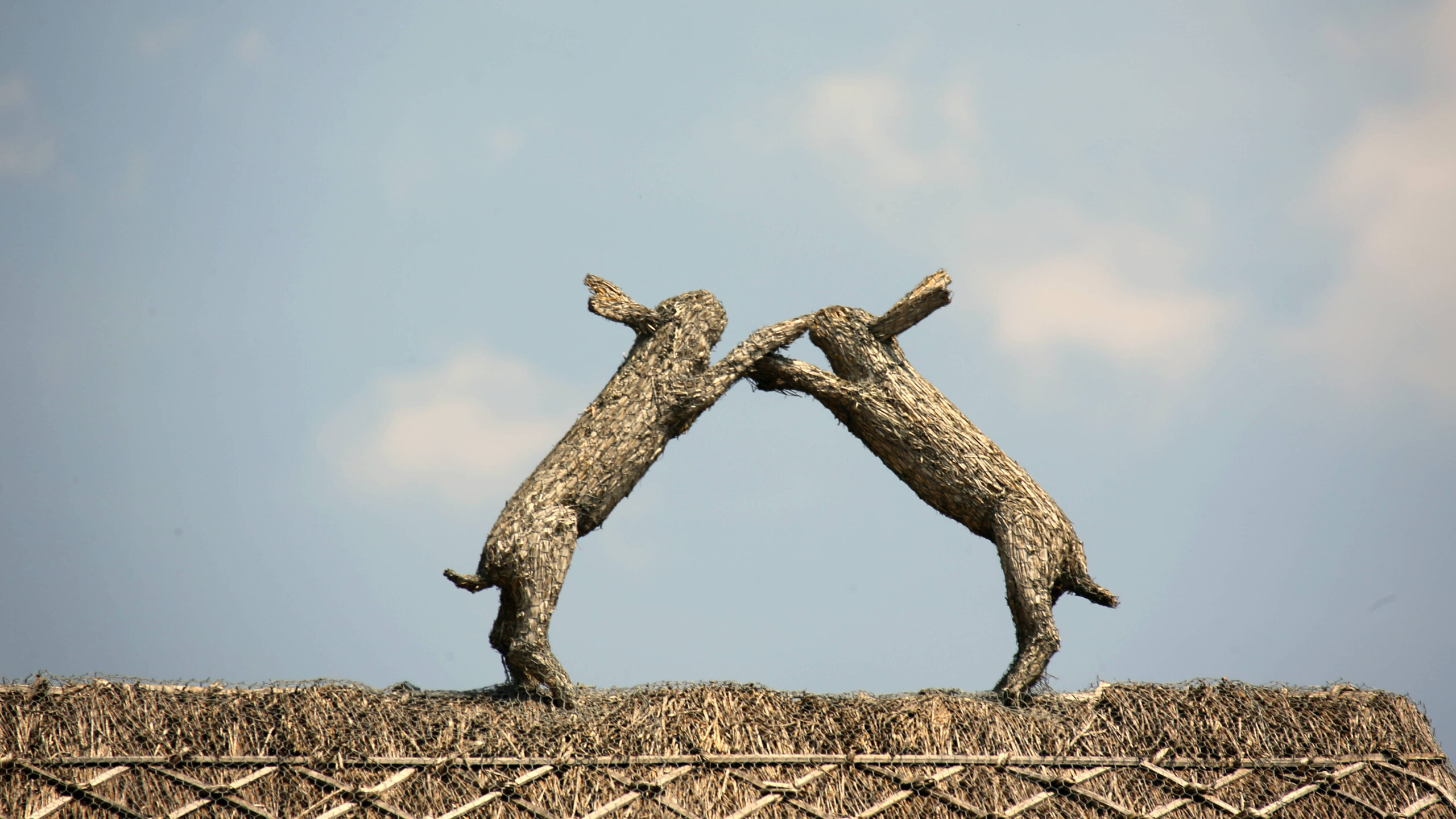
Standing upright on their hind legs with forepaws raised, the pair appear locked in an eternal contest above the roofline. Their dynamic pose has become one of the defining images of traditional ornamental thatching.
A fine contemporary example can be seen on a thatched cottage on Robin Hood Road in Elsenham, Essex, where a beautifully executed pair of woven boxing hares crowns the ridge. The finial demonstrates the remarkable skill of the master thatcher, with the hares poised in perfect balance, their raised forepaws meeting at the centre as if frozen in the middle of one of nature’s most dramatic spring rituals. It is a striking reminder that decorative ridge work is not merely a relic of the past but a living craft that continues to enhance Britain’s historic homes.
What makes the design especially compelling is that it begins with a real event observed in the fields of Britain.
Nature’s Own Performance
Each spring, brown hares engage in dramatic boxing matches.
For centuries, people assumed these contests involved rival males fighting for mates. Modern wildlife research has revealed a more nuanced picture. In many cases, the boxing hare is actually a female fending off an overenthusiastic male. Standing upright, she strikes repeatedly with her forepaws until the pursuer retreats or proves worthy of continuing the chase.
The display is energetic, graceful, and surprisingly theatrical.
Country people who witnessed these encounters naturally attached meaning to them long before wildlife biology could explain the behaviour.
A Symbol of Fertility
Hares have long symbolised fertility and abundance.
Their extraordinary breeding capacity, combined with their emergence in the early signs of spring, made them powerful emblems of renewal in agricultural communities.
A pair of boxing hares, therefore, came to represent far more than conflict.
They embodied courtship.
They announced the arrival of spring.
They celebrated the renewal of life after winter.
Placed atop a newly completed roof, they quietly expressed hopes that the household beneath would enjoy prosperity, healthy children, successful harvests, and good fortune.
Folklore and Mystery
Few British animals have attracted more folklore than the hare.
In medieval and early modern Britain, hares were frequently associated with witchcraft, shape-shifting, and the supernatural. Stories told of witches escaping across moonlit fields in the form of hares, only to be recognised by mysterious wounds that later appeared on their human bodies.
Elsewhere, hares became linked with the moon because of their nocturnal habits and seasonal breeding cycles.
These stories reveal less about supernatural belief than they do about the fascination inspired by an animal that appeared suddenly at dawn, vanished without warning, and seemed almost impossible to catch.
The boxing hares ‘ final draws upon this rich body of folklore without belonging to any single myth.
Ancient Symbol or Modern Tradition?
One of the most persistent claims surrounding boxing hare finials is that they descend directly from ancient Celtic religion or prehistoric fertility rites.
The evidence does not support such certainty.
While the hare has undoubtedly held symbolic importance for thousands of years, decorative boxing-hare finials are best understood as a comparatively modern development within the long tradition of ornamental ridge work. They draw inspiration from older symbolism rather than preserving an unbroken religious tradition.
This distinction matters.
The design is no less meaningful because its exact origins cannot be traced to a single ancient source. Its power comes from the way generations of craftsmen combined careful observation of nature with inherited rural symbolism.
Thatcher’s Masterpiece
Among today’s master thatchers, producing a pair of boxing hares remains one of the greatest demonstrations of ornamental skill.
Each animal must be perfectly balanced.
The raised forelegs create movement.
The ears provide elegance.
The bodies must remain symmetrical while withstanding years of weather.
From ground level, the finished figures appear almost alive, caught forever in that fleeting spring moment when instinct, energy, and survival collide.
Few other decorative finials demand such precision.
For this reason alone, the boxing hares have become something of a hallmark for exceptional craftsmanship.
A Living Tradition
Decorative straw finials continue to evolve.
Modern thatchers still create traditional birds, crosses, wheat sheaves, and hares, while occasionally introducing contemporary designs that reflect local wildlife or personal commissions.
Yet despite changing tastes, the purpose remains remarkably consistent.
A decorative finial marks the completion of skilled work.
It celebrates natural materials.
It honours generations of craftsmen who transformed ordinary straw into enduring works of art.
Among them all, the two boxing hares stand apart. They are not merely ornaments. They are a celebration of Britain’s countryside itself. A reminder that the finest traditions often begin with careful observation of the natural world and survive because each generation finds new meaning in old straw, patient hands, and stories carried on the wind.
* Have you spotted something happening in Elsenham or Henham? Let us know through our contact form. *

Author: Martin Foskett
me