Image by: Knelstrom Media
See Something Suspicious? Tell the Authorities, Not Just Facebook
By Martin Foskett, Reporter
PUBLISHED:
UPDATED:
There was a time when finding somebody’s lost property meant trying to return it, spotting an insecure vehicle meant alerting someone responsible, and witnessing suspicious behaviour meant considering whether the police ought to know.
Today, apparently, there is another option.
Photograph it, put it on Facebook and wait for the comments.
Community Facebook groups have become an established part of village life. They reunite missing pets with their owners, publicise events, share information about road closures and occasionally provide a useful warning about something happening locally.
They can be genuinely valuable.
But I am becoming increasingly concerned about a particular habit developing within them. People appear so accustomed to broadcasting problems that they sometimes overlook the practical steps needed to resolve them.
And as two recent examples from Stansted Mountfitchet and Stansted Airport show, the consequences could be far more serious than a few unnecessary Facebook comments.
The first involved a purse found near the Co-op in the Lower Street car park at Stansted Mountfitchet.
According to the Facebook post, someone found the purse and left it on a railing. The post then advertised its location online, apparently hoping its rightful owner would see it and retrieve it.
The intention was presumably helpful.
But consider what had actually happened.
An unattended purse had been discovered in a public place. Instead of securing it or asking whether the nearby shop could help, its exact whereabouts were announced to an audience of strangers.
That audience might include its owner.
It might also include somebody considerably less interested in returning it.
There is no evidence that the purse was stolen, and I sincerely hope its owner recovered it. Nevertheless, the decision raises an obvious question.
Why advertise the location of potentially valuable property before taking reasonable steps to protect it?
Then came another example, this time at Stansted Airport.
A Facebook user posted photographs of a black BMW parked in the green short-stay car park, explaining that its left rear window had been left open.
Once again, the apparent intention was to help.
Unfortunately, the post also provided several pieces of information that somebody with rather different intentions might find extremely useful.
It identified the make and colour of the vehicle, showed photographs of it, specified the car park and publicly announced that a window had been left open.
At an airport, where motorists may be travelling away from their vehicles, that information is potentially sensitive.
One commenter observed that the owner was probably already on the plane.
Quite possibly.
Which makes the practical value of the Facebook warning even more questionable.
An owner sitting aboard an aircraft, perhaps already preparing for departure, is hardly in an ideal position to return to the car park and secure the vehicle.
Airport parking staff or security personnel, however, might have been able to investigate the situation and consider whether the owner could be contacted.
The screenshots do not establish whether anybody notified them. It would therefore be unfair to suggest that no such action was taken.
But the public post itself raises a troubling issue.
By warning the world that a vehicle had been left insecure, could somebody inadvertently make that vehicle more vulnerable?
The answer is that they potentially could.
A criminal looking for an opportunity does not necessarily need to discover every vulnerability personally. Sometimes useful information is volunteered by someone with absolutely no intention of assisting a crime.
This does not make the person posting a criminal.
Under English law, criminal responsibility for assisting or encouraging an offence involves specific legal requirements. A well-intentioned social media post does not automatically make its author an accomplice if somebody subsequently commits a theft.
But legal liability and practical consequences are two very different questions.
A person can act with the best intentions and still make a situation worse.
And that, I believe, is the much larger problem.
Consider the information routinely shared across community Facebook groups.
An unfamiliar vehicle photographed outside somebody’s house. A stranger captured on a doorbell camera. A suspicious-looking person walking through a residential area. A property apparently left unattended.
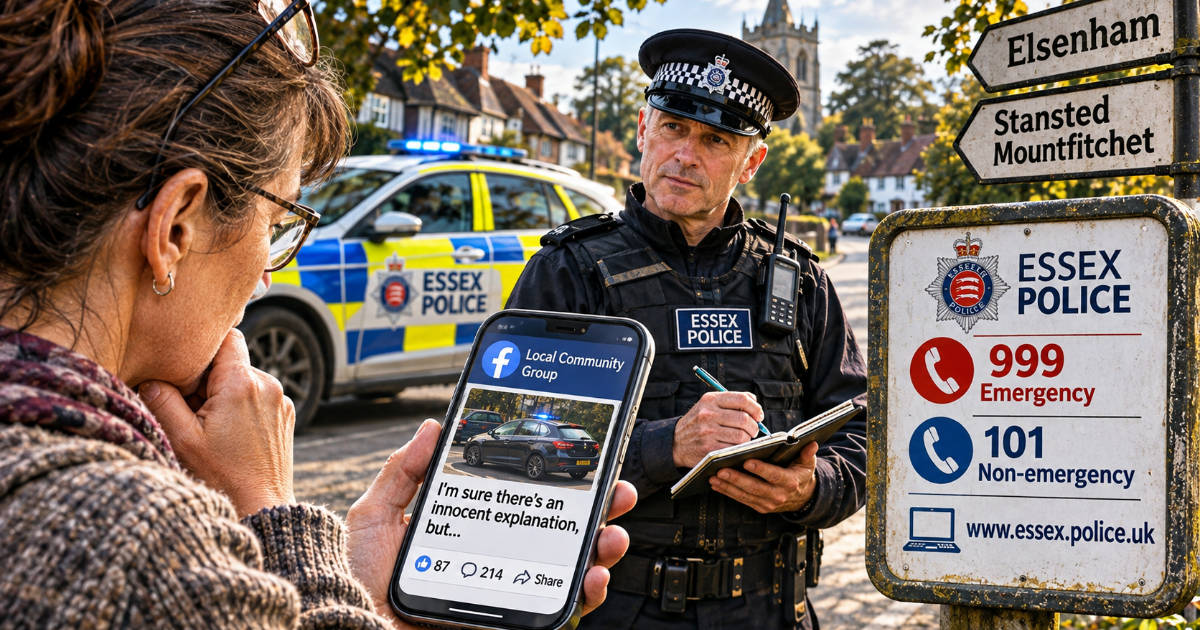
Some posts begin with the familiar qualification: “I’m sure there’s an innocent explanation, but…”
What follows can be a remarkable exercise in collective speculation.
A person nobody recognises becomes suspicious simply because nobody recognises them. A parked car attracts theories about criminal surveillance. A perfectly ordinary visitor finds their photograph circulating among hundreds of residents.
Yet there may be no evidence of wrongdoing whatsoever.
The damage isn’t necessarily limited to unfair suspicion.
A public post can also disclose information that would have been better shared privately with someone capable of acting on it.
A photograph might reveal a vulnerable entrance. A description might identify an insecure vehicle. A discussion might inadvertently confirm that a property is unoccupied.
None of these disclosures has to be malicious to be potentially harmful.
And once information has been copied, shared or captured in a screenshot, removing the original post may not remove the risk.
That is what makes this habit so concerning.
People are not merely describing problems. In some circumstances, they may be publishing opportunities.
The distinction matters enormously.
If somebody finds a purse, the priority should be to protect it and make reasonable efforts to return it.
If somebody notices an insecure vehicle in a managed car park, the sensible response is to notify the operator or security staff.
If somebody witnesses a crime or has genuine grounds to suspect criminal activity, the appropriate response is to contact the police.
Facebook can still play a supporting role where useful, but it should not automatically be the first destination for every concern.
Another consequence is particularly relevant to villages such as Elsenham and Stansted Mountfitchet.
Residents regularly express frustration about policing, crime and the perceived lack of attention given to smaller communities.
Some of those complaints are entirely justified.
But there is a contradiction in expecting the police to understand what is happening locally while reporting potentially relevant incidents exclusively to Facebook.
An unfamiliar vehicle seen in Elsenham might mean nothing.
A similar observation elsewhere might also appear insignificant.
But if police receive reports containing relevant details, they may be able to recognise connections that individual residents cannot.
That is particularly important across rural communities, where related incidents may occur in several villages rather than one obvious location.
A resident in Elsenham cannot reasonably be expected to know whether something they witnessed is connected to an incident in Stansted Mountfitchet, Takeley or Great Dunmow.
The police are better placed to assess that possibility.
But they need information.
And a Facebook comment is not an official report.
This does not mean every suspicious incident constitutes a crime. Nor does it mean that reporting an unfamiliar vehicle will automatically increase police-recorded crime figures or produce additional officers.
Police funding and operational decisions involve considerably more than the number of reports received.
Nevertheless, information from residents can help officers understand local concerns, assess risks and identify patterns. Where actual crimes are not reported, the official picture of offending can also be incomplete.
When people stop reporting incidents because they believe nothing will happen, they risk contributing to a situation in which the police have less information about what is happening.
The result can become a vicious circle.
Residents believe the police are doing too little, so they become reluctant to contact them. Potentially useful information never reaches the force. Residents then see little evidence of action and become even more convinced that reporting is pointless.
Meanwhile, Facebook has accumulated another fifty comments, three competing theories and a photograph of somebody’s delivery driver.
None of this is an argument against neighbours looking out for one another.
Quite the opposite.
A community in which people notice unusual circumstances, care about lost property and take an interest in local safety is something worth encouraging.
But concern needs to be accompanied by judgement.
Before publishing photographs, locations or identifying details, people ought to consider three straightforward questions.
Who actually needs this information?
Who is in a position to do something useful with it?
And could making it public create a problem that did not previously exist?
Those questions are particularly important when somebody else’s property, privacy or reputation is involved.
For residents across Elsenham, Stansted Mountfitchet and the surrounding villages, the practical options are straightforward.
Where a crime is in progress, or somebody is in immediate danger, call 999.
For non-emergency police matters, contact Essex Police on 101 or use the online reporting service at www.essex.police.uk.
Where a problem concerns an airport car park, railway station, shop or other managed premises, notifying the relevant staff or security personnel may be the most effective immediate step.
Not every concern requires a police response. Not every unusual circumstance is suspicious. And not every report will result in an investigation.
But those are decisions best made using the relevant facts, rather than by inviting an entire Facebook group to reach a verdict.
I would much rather see a community post explaining that a concern has already been reported to the appropriate people, and asking anyone with useful information to contact them, than another public announcement of somebody else’s vulnerability.
The lost purse and the BMW are different incidents, but they illustrate the same underlying problem.
In both cases, somebody apparently wanted to help.
In both cases, information was placed into the public domain.
And in both cases, there is a legitimate question about whether the publicity itself might have introduced an unnecessary risk.
I am not suggesting that either poster intended harm. Nor is there evidence from these posts that either incident resulted in a theft.
The point is that good intentions don’t guarantee good outcomes.
Community responsibility involves more than noticing a problem and telling everybody about it.
It involves thinking about what happens next.
Who might see the information? What might they do with it? Could somebody be unfairly accused? Could an unattended possession become more vulnerable? Could a genuine concern be overlooked because nobody reported it to the people equipped to investigate?
These questions aren’t complicated, but they deserve to be asked before pressing the publish button.
Social media has made it extraordinarily easy to tell hundreds of people about something in seconds.
It has not necessarily made us any better at deciding whether those hundreds of people ought to know.
A warning is only helpful if it reduces the danger. If it advertises the opportunity instead, it may achieve precisely the opposite.
And that is why the next time somebody discovers an insecure vehicle, finds lost property or witnesses something genuinely suspicious, I hope their first thought is not how quickly they can get it onto Facebook.
I hope it is how best to protect the people and property involved.
Because community safety is not measured in likes, shares or comments.
It is measured by what people actually do.
Before telling everybody about a problem, tell somebody who can do something about it.
Support the Elsenham Herald
The Herald is independently published and free for everyone to read. If you’d like to help, please consider liking, sharing, and commenting on our articles; recommending us to friends and neighbours; or submitting local news, events, and photographs. You can also support our work financially. Every action, no matter how small, helps us continue providing accurate, fair and transparent local journalism for Elsenham and the surrounding villages.
Learn more at our Support the Herald Page.

Author: Martin Foskett
is the founder and editor of the *Elsenham Herald* and director of Knelstrom Ltd. With more than 30 years of experience in freelance journalism, photography and video reporting, he brings an independent, inquisitive and occasionally irreverent perspective to local affairs. Born in Bishop's Stortford and raised in Great Canfield, Martin has longstanding connections to Elsenham and the surrounding villages. His writing focuses on community issues, local history, public accountability and the decisions that affect everyday life. A firm believer in independent journalism, common sense and asking uncomfortable questions, Martin believes that local news should do more than repeat announcements. It should inform residents, challenge decisions, scrutinise those in authority and give communities a voice. When something doesn't add up, he believes it's worth asking why.