
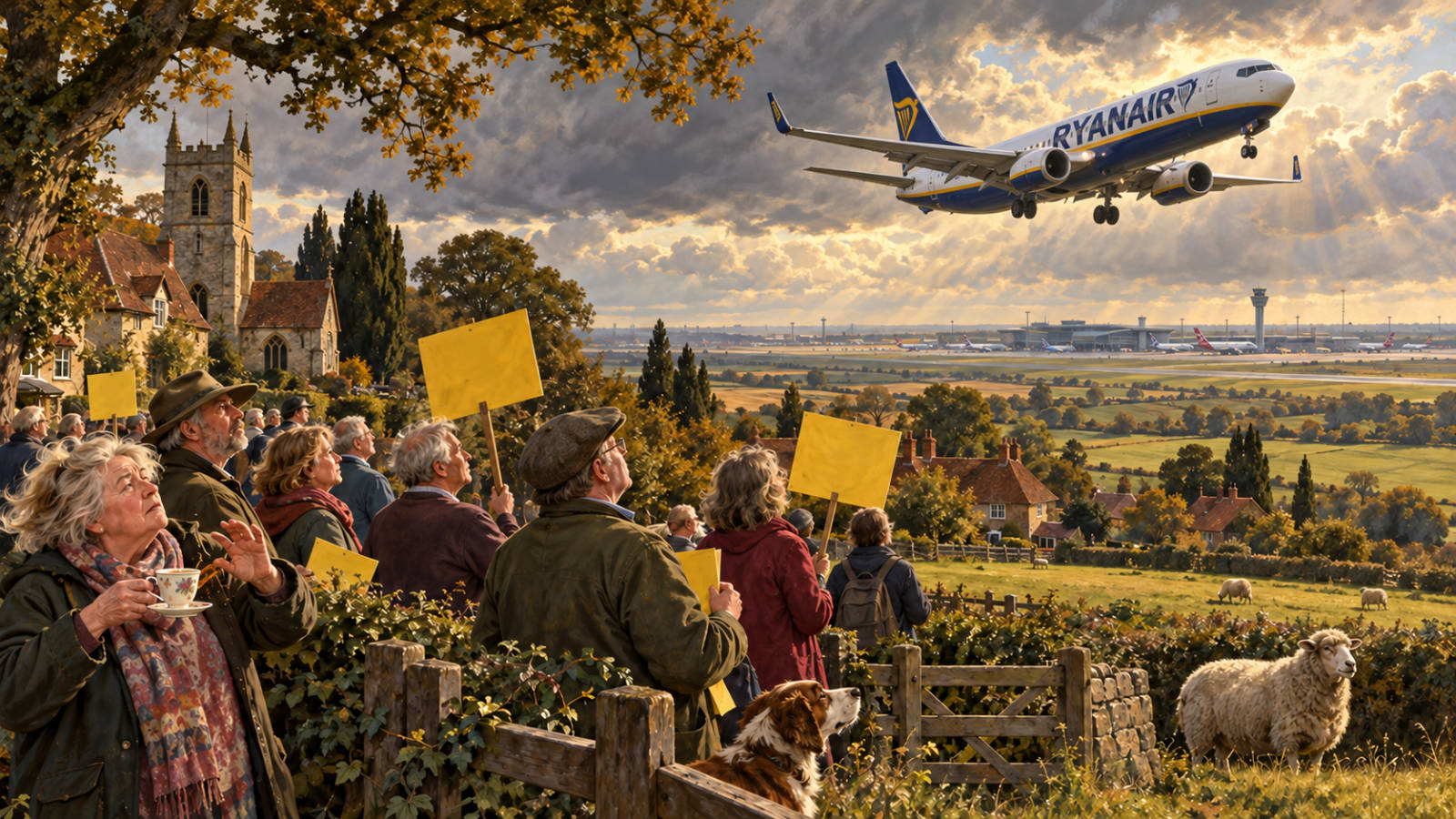
Image by: Knelstrom Media
The rise and fall of Stop Stansted Expansion.
By Martin Foskett, Reporter
PUBLISHED:
UPDATED:
The campaign that won the battle but outlived its purpose
For nearly a quarter of a century, determined Essex residents took on governments, multinational airport operators, and some of the most ambitious aviation expansion plans in British history. Armed with yellow placards, legal arguments, and an extraordinary capacity for attending public meetings, Stop Stansted Expansion became one of the country’s most formidable local campaigning organisations.
It achieved what many had considered impossible. It helped stop Stansted Airport getting a second runway.
Yet victory brought a problem few campaigns are adequately prepared to face. What happens when the battle that created an organisation has been won, but the organisation itself has no intention of disappearing?
By 2021, Stop Stansted Expansion had become Stansted Airport Watch. Three years later, its membership organisation was being replaced by a foundation. By July 2026, that foundation had been voluntarily dissolved.
Meanwhile, the airport had secured council approval to handle 51 million passengers annually.
It was a remarkable journey from grassroots resistance to an increasingly uncertain institutional future.
The campaign’s roots stretched back to 1965, when the North West Essex and East Herts Preservation Association formed to oppose proposals to transform Stansted into London’s third major airport.
The concerns were hardly surprising. The surrounding countryside consisted of established villages, historic buildings, farmland and communities whose residents had generally settled there for reasons other than an enthusiasm for international aviation infrastructure.
For decades, successive governments wrestled with Britain’s growing appetite for air travel. Stansted repeatedly appeared in their calculations, helped by its existing runway and convenient proximity to London.
In 1991, the airport’s modern terminal opened, transforming Stansted’s commercial prospects. The following decade saw low-cost airlines accelerate passenger growth, and the Government began looking for somewhere to accommodate considerably more aircraft.
In July 2002, the Department for Transport launched a consultation considering options for up to three additional runways at Stansted.
The response was immediate.
Stop Stansted Expansion, operating under the umbrella of the earlier preservation association, was established in August 2002. Approximately 800 people attended its first public meeting at Stansted Mountfitchet School.
The following month, a rally at Easton Lodge attracted around 2,000 participants. Yellow placards bearing the campaign’s unmistakable black aircraft silhouettes began appearing across the district.
In November, an Uttlesford poll produced an emphatic result. With 69 per cent of ballot papers returned, 89 per cent of respondents opposed additional runways.
Unfortunately for residents, Westminster had developed the familiar political ability to consult the public without necessarily accepting the answer.
In December 2003, Labour’s Air Transport White Paper backed a second runway at Stansted, envisaging it opening by 2011 or 2012.
The campaign now had a clearly defined opponent and an equally clear objective.
Under chairman Peter Sanders, appointed in 2004, SSE went beyond a typical village protest. It commissioned research, examined aviation forecasts, challenged government policy, scrutinised planning applications and built relationships across the political spectrum.
Its patron included former hostage negotiator Terry Waite, while volunteers organised fundraising events, produced campaign literature and developed an increasingly sophisticated understanding of the planning system.
The consequences of a second runway were substantial. BAA, the airport’s owner, acquired about 270 local homes to prepare for expansion. Villages including Broxted and Takeley faced significant disruption, while extensive areas of countryside risked permanent transformation.
By March 2008, BAA had submitted its formal application.
The contest was no longer merely about aircraft noise or inconvenience. It concerned the possible destruction of homes and landscapes, the future of established communities, and how far national infrastructure policy should override local interests.
For SSE, defeat was a real prospect.
Then politics intervened.
After the 2010 general election, the newly formed Conservative-Liberal Democrat coalition withdrew government support for additional runways at Stansted.
On 24 May 2010, BAA abandoned its second runway planning application.
It was SSE’s defining victory.
The organisation could not claim sole responsibility for the decision. National politics, economic conditions, and broader environmental arguments all contributed. Nevertheless, years of determined campaigning had turned what once seemed inevitable into something politically unacceptable.
Against considerable financial and institutional resources, the residents had prevailed.
An airport runway that might have transformed north-west Essex was never built.
Victory, however, did not end the argument.
Manchester Airports Group purchased Stansted in 2013 for £1.5 billion. New runway possibilities resurfaced during the Airports Commission process, although Stansted was not shortlisted for an immediate additional runway.
The campaign remained active, but the focus increasingly shifted towards passenger numbers, aircraft movements, noise, emissions and the effects of operating the existing airport more intensively.
This was a different kind of struggle.
A proposed second runway was an obvious threat. It had a physical location, identifiable consequences and a development plan residents could rally against.
An incremental increase in passenger capacity was more complicated. It required planning conditions, forecasts, environmental assessments, and technical arguments that were less likely to inspire thousands to assemble in a field.
Meanwhile, the airport had its own economic case.
Stansted provided employment, supported local businesses and offered affordable international travel. More passengers brought opportunities, but also costs. Not every resident regarded airport growth as undesirable.
The original battle had offered a relatively straightforward choice. The next phase required balancing competing interests, often involving people living in the same communities.
In 2018, Uttlesford District Council initially supported proposals to increase Stansted’s annual passenger limit from 35 million to 43 million. Following the 2019 local elections, the council reconsidered the application and refused permission in January 2020.
The airport appealed.
In May 2021, planning inspectors overturned the refusal, approved the increase, and awarded the airport its appeal costs against Uttlesford District Council, whose conduct they criticised.
The decision represented a significant setback for opponents of further airport growth. Unlike the second runway battle, this contest ended in the airport’s favour.
It also exposed the limits of political resistance when faced with the planning system’s evidence requirements and procedures.
By this point, SSE was undergoing its own transformation.
In May 2021, the organisation adopted the name Stansted Airport Watch. Peter Sanders, then aged 82, stepped down after seventeen years as chairman, with long-serving deputy Brian Ross taking over.
The change was presented as a practical adjustment rather than an admission of defeat.
The original Stop Stansted Expansion campaign would become dormant, while the wider organisation would focus on monitoring environmental effects, noise, flight paths, emissions, and aviation policy.
The COVID-19 pandemic had dramatically reduced passenger traffic. Campaign leaders believed Stansted might not reach its existing passenger cap for another decade, making further expansion seem remote in the short term.
That was a reasonable assessment at the time, though the subsequent recovery in air travel showed how unreliable long-term aviation predictions can be.
The new name reflected a broader mission, but it also erased the campaign’s original identity.
Stop Stansted Expansion had been direct, unmistakable and confrontational.
Stansted Airport Watch suggested continuing oversight rather than an impending battle.
The transformation also revealed a more fundamental problem.
The organisation had relied heavily on experienced volunteers who had devoted decades to its work. Those volunteers were growing older, and replacing them was becoming increasingly difficult.
In November 2023, chairman Brian Ross announced proposals to wind down the membership organisation and establish the Stansted Airport Watch Foundation.
The explanation was refreshingly straightforward. Senior campaigners were retiring after more than twenty years of voluntary service. The organisation no longer had the people required to maintain its existing structure indefinitely.
The proposed foundation would inherit about £90,000 in assets, preserve resources for future community work, and potentially provide starting funds for another campaign if the second runway threat returned.
It was intended to provide continuity without the expense and obligations of maintaining a conventional campaigning organisation.
Regular subscriptions, newsletters, website, and office services were to disappear.
A movement once capable of mobilising thousands of residents would become something altogether quieter: an investment fund overseen by a small group of directors.
On 11 June 2024, Stansted Airport Watch Foundation C.I.C. was incorporated.
Yet even this final arrangement proved short-lived.
On 15 April 2026, an application was filed to strike the company off the register. Companies House records the formal dissolution as taking effect on 14 July 2026.
This was a voluntary strike-off, not evidence of insolvency or financial wrongdoing. The publicly available dissolution record does not, by itself, establish why the directors chose to close the company or the ultimate disposition of its assets.
Nevertheless, the significance was considerable.
The succession of organisations that had emerged from the original SSE campaign had reached a formal conclusion.
The timing carried a particular irony.
In December 2025, Uttlesford councillors had supported a further increase in Stansted’s annual passenger limit to 51 million, subject to final legal agreements and planning conditions.
The airport argued that it could accommodate this growth using larger aircraft and its existing runway, without increasing the permitted number of aircraft movements.
It also pointed towards employment, investment, improved connectivity and broader economic benefits.
For surrounding communities, the familiar questions about aircraft noise, traffic, infrastructure and environmental pressures remained.
The airport had recovered from the pandemic and recorded more than 30 million passengers during 2025, its busiest year.
The campaign organisation, by contrast, was approaching its final administrative departure.
It would be tempting to describe the entire story as a defeat. That would overlook what SSE actually accomplished.
A second runway was once central to government aviation policy. It attracted a major airport operator’s attention and resources, threatened hundreds of homes, and seemed inevitable to many observers.
It was never built.
That achievement remains part of north-west Essex’s history, whatever happened to the organisation responsible for helping bring it about.
Yet the decline of SSE and its successors illustrates a recurring problem facing grassroots campaigns.
Opposition can unite people around a common objective. Victory removes the urgency. Volunteers move on, supporters lose interest, finances become harder to justify, and organisations created for an extraordinary confrontation find themselves attempting to survive through ordinary administration.
The transition from protest movement to permanent institution is rarely straightforward.
Stop Stansted Expansion was extraordinarily effective when it had something specific to stop. Stansted Airport Watch tried to keep the campaign relevant in a world where airport development increasingly happened through incremental planning decisions rather than grand proposals for new runways.
Ultimately, even its attempt to preserve the campaign’s legacy through a foundation ended.
The foundation’s dissolution does not mean local concern about Stansted has vanished, nor does it mean future residents cannot organise again. It does mean that the particular organisational structure inherited from the great second runway campaign no longer survives in its final corporate form.
Its history offers a lesson like public campaigning.
Winning a battle is difficult. Building an organisation capable of surviving its greatest victory can be harder still.
Stop Stansted Expansion helped prevent another runway from being built. Twenty-four years after the campaign began, the airport was still expanding, but the organisation that once stood in its way had reached the end of its own runway.
Support the Elsenham Herald
The Herald is independently published and free for everyone to read. If you’d like to help, please like, share, and comment on our articles; recommend us to friends and neighbours; or submit local news, events, and photographs. You can also support our work financially. Every action, no matter how small, helps us continue providing accurate, fair and transparent local journalism for Elsenham and the surrounding villages.
Learn more at our Support the Herald Page.
CATEGORIES:
TAGS:

Author: Martin Foskett
me