Image by: Knelstrom Media
New Road falls. Elsenham prepares for another summer campaign
By Martin Foskett, Reporter
PUBLISHED:
UPDATED:
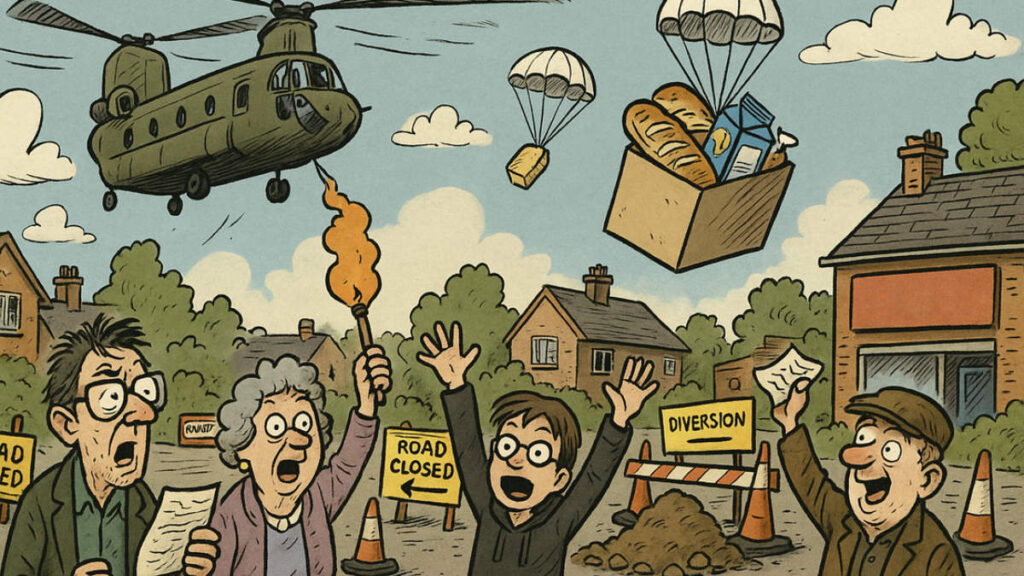
There comes a point every summer when the village collectively stops asking whether the roadworks are finished and instead begins asking which road has volunteered itself next. June has now answered that question with the confidence of a man arriving at a barbecue carrying only an empty plate. The operational map has shifted once again. New Road is preparing to disappear behind barriers for five days; temporary traffic lights have multiplied like particularly determined rabbits; Stansted’s approaches remain wrapped in utility works; the M11 Junction 8 continues its nightly impression of organised confusion; and even Tye Green Road has received official notice that its turn is coming. Somewhere inside Central Operations Command, someone quietly unfolded a larger map.
Barry was the first to identify the scale of the situation. Standing beside the bourbons in Tesco with the seriousness usually reserved for military logistics, he spread three packets of digestive biscuits across the shelf to represent the village’s remaining viable escape routes. “Never trust simultaneous infrastructure,” he announced to nobody in particular. “It’s how empires collapse.” Mark Price, ever calm behind the meal-deal front, assured shoppers that sandwich supplies remained stable. However, several regulars noticed he had discreetly doubled the stock of family packs of Hobnobs, which in Elsenham counts as a declaration of operational readiness.
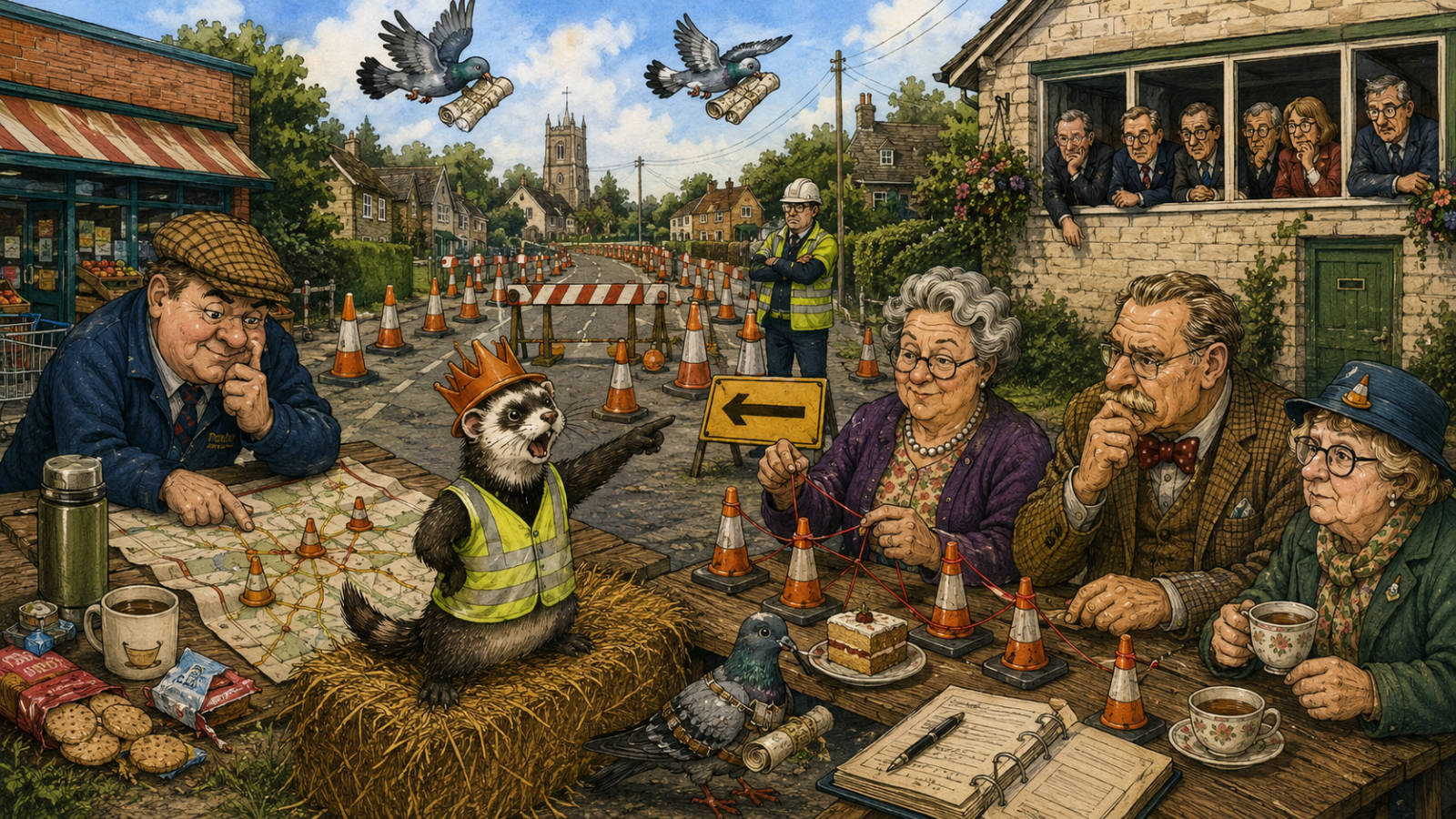
Sara, Head of Tactical Intelligence and Tracking Section, had already released her pigeons before breakfast. The birds completed two reconnaissance circuits above New Road before returning with expressions that suggested they had seen far too many temporary traffic management signs for one morning. Her dogs refused to use the normal walking route altogether, choosing instead to lead villagers through side streets with the quiet confidence of creatures who had accepted that humans were once again making transport unnecessarily complicated.
By the time Colin the Ferret emerged from beneath the hedge outside the Post Office, wearing his regulation miniature high-visibility vest and the ceremonial cone balanced proudly upon his head, the mood had become almost businesslike. Colin inspected the first stack of diversion signs with visible disappointment before scratching angrily at the pavement. Infrastructure, in his view, continued to display an unacceptable lack of respect. He sniffed each traffic cone individually, paused beside one particularly fresh example, then looked back towards Barry with the expression of a field commander discovering the enemy had captured another bridge overnight.
The Central Operations Command assembled in the Crown shortly afterwards. Will N. Power produced coloured pins. Gordon adjusted his traffic cone cravat with solemn dignity. Sheila opened her six-ring binder to a fresh page entitled “June Escalation”. Tea was poured with the measured caution of people discussing troop movements rather than road closures.
Nobody panicked. That was the official position. Instead, they calmly reviewed intelligence. New Road will close completely between 22 and 26 June for utility works. Throughout the month, temporary lights would continue to appear across the village whenever electricity, water, or telecommunications held another conference beneath the carriageway. The approaches to Stansted Airport remained under continuous engineering attention, ensuring that journeys that should have taken minutes now had enough time for meaningful personal reflection. Meanwhile, M11 Junction 8 continued its overnight programme of lane closures, meaning every late evening driver approached the motorway with the emotional confidence of someone opening a mystery parcel. Tye Green Road had also received a formal warning from Affinity Water with works
Margaret listened in complete silence while constructing what could only be described as an edible intelligence display from Scotch eggs, cocktail sausages and slices of Victoria sponge. She eventually pointed towards New Road using a plastic fork. “It’s all connected,” she declared. Nobody asked how. Experience had taught them that Margaret’s theories often sounded ridiculous until roughly three weeks later, when reality caught up.
Joe, reporting with his usual BBC calm from the level crossing, confirmed that everyone should leave earlier than they thought necessary and possibly return later than expected. “The trains,” he observed, “continue to ignore the roadworks completely, which some motorists find unnecessarily provocative.” Nobody disputed him.
Elsewhere, the Parish Council continued its own campaign against the relentless machinery of village administration. The June meeting moved steadily through planning applications, community projects, playing field inspections, architectural tenders, and pond discussions, with the sort of measured determination only parish councils can muster, while outside, the transport network quietly reinvented itself yet again. Members also discussed tree loss, local drainage concerns, blocked footpaths, planning decisions, the Community Centre project and preparations for ongoing village maintenance. Everything was noted. Everything was minuted. Everything proceeded with admirable composure despite the increasingly theatrical state of the roads beyond the hall.
By late afternoon, the first unofficial diversion maps had begun circulating through WhatsApp groups. Sue Veillance already knew which residents would ignore them. Ray Darr was studying likely traffic displacement with the enthusiasm of a man who considered radar guns an extension of his personality. Chris P. Batter at the Fish Bar shrugged. “Roadworks or not,” he said while wrapping cod with surgical precision, “people still need chips. That’s civilisation.”
As evening settled across the village, Colin climbed onto his favourite straw bale overlooking Hall Road. He surveyed the growing collection of cones standing silently in the last of the daylight. Beyond the hedgerows, the fading sun caught the reflective bands on the barriers, making them shimmer just enough to look faintly smug. Barry appeared beside him carrying a flask and a packet of custard creams. Neither spoke for several minutes. They simply watched another contractor’s van disappear into the distance, secure in the knowledge that somewhere beneath Elsenham, another section of pipe, cable or duct had once again become the most important object in Essex.
And so June enters the Siege records exactly as expected, not with explosions or catastrophe, but with paperwork, barriers, temporary lights, and another carefully planned reshaping of daily life that everyone will grumble about while quietly adapting within forty-eight hours. New Road falls. The diversion signs multiply. Colin remains unconvinced. Barry updates the biscuit reserves. The tunnels continue beneath our feet, whether anyone admits they exist or not. The Siege of Elsenham rolls on, not because anybody wishes it to, but because somewhere, someone has just issued another permit.
* Have you spotted something happening in Elsenham or Henham? Let us know through our contact form. *

Author: Martin Foskett
me