
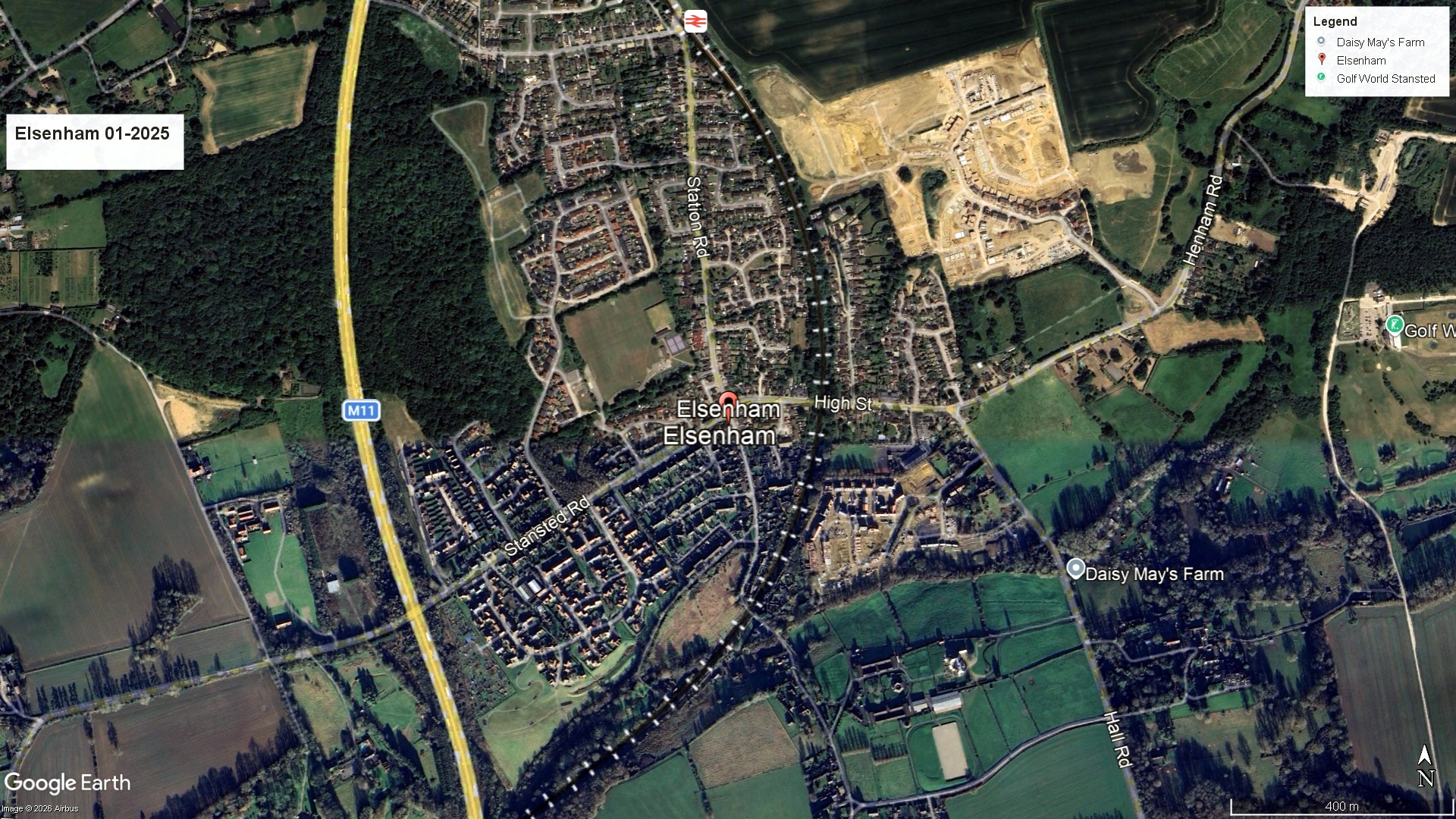
Image by: Google Earth
Elsenham: 26 Years of Change (2000–2026)
By Martin Foskett, Reporter
PUBLISHED:
UPDATED:
At the start of the millennium, Elsenham was a village of around 2,500 people. Surrounded by farmland and characterised by its railway station, historic core and proximity to Stansted Airport, it occupied a distinctive position between rural Essex and a rapidly changing regional economy.
Twenty-six years later, the village has grown significantly. New housing estates have expanded its footprint, the population has increased, travel patterns have evolved, and local services have adapted to changing demands. Yet despite substantial development, many of the characteristics that have defined Elsenham for generations remain visible in daily village life.
The story of Elsenham between 2000 and 2026 is not one of sudden transformation. Instead, it is a gradual process of growth that reflects wider changes across Uttlesford and the London commuter belt.
A Village at the Turn of the Century
In 2000, Elsenham was still largely defined by its historic village centre, traditional housing stock and surrounding agricultural landscape. The railway station provided regular connections to London and Cambridge, making the village attractive to commuters, although this trend was less pronounced than it would become in later years.
Stansted Airport was already a major presence. Located only a few miles away, it influenced employment patterns and transport infrastructure throughout the area. Many residents worked directly or indirectly in airport-related industries, while others travelled further afield for employment.
Village facilities included local shops, schools, public houses, churches and community organisations that served a relatively stable population. While housing development had occurred during previous decades, the scale remained modest compared with what would follow.
Housing Growth and Expansion
The most visible change over the past twenty-six years has been residential development.
During the early 2000s and into the following decades, a series of housing schemes increased the number of homes within the village. New estates expanded the built-up area and introduced a broader mix of housing types.
The largest change came through developments associated with the former Elsenham Golf and Leisure complex. Planning debates surrounding housing numbers, infrastructure provision and the future shape of the village became a recurring feature of local discussion.
Supporters of development often pointed to the need for new homes and opportunities for younger families to remain within the area. Others raised concerns about traffic, school capacity, healthcare provision and the impact on the village’s character.
These discussions reflected wider planning debates taking place across Uttlesford, where pressure for housing growth has remained a significant issue throughout the period.
As new homes were completed, the population increased. New residents arrived from nearby towns, London and elsewhere in the South East, bringing different commuting patterns and service demands.
The Railway and Changing Travel Patterns
Elsenham station has continued to play an important role in village life.
The growth of flexible working, improved digital connectivity and changing employment patterns have altered how residents use the railway, particularly since the Covid-19 pandemic. Nevertheless, rail links remain one of the village’s strongest assets.
For many households, access to Cambridge, Bishop’s Stortford and London continues to influence decisions about where to live.
Road traffic has also increased over the past twenty-six years. Residents have frequently raised concerns regarding congestion, parking pressures and traffic movements through the village. These issues have become more noticeable as population levels have risen and regional development has continued.
The relationship between Elsenham and Stansted Airport has remained an important factor throughout this period. While the airport provides employment opportunities and transport connections, discussions regarding aircraft noise, traffic and future expansion have periodically returned to the local agenda.
Community Facilities Under Pressure
Population growth has created both opportunities and challenges for local services.
Schools have seen increasing demand. Healthcare provision has faced pressures familiar to many communities across England. Community organisations have adapted to serve a larger and more diverse population.
The village has continued to support a wide range of clubs, societies and voluntary groups. These organisations often provide continuity during periods of physical change, helping newer residents become involved in local life.
Village halls, sports facilities and recreational spaces have remained important gathering points. As housing growth has accelerated, discussions about the adequacy of community infrastructure have become more frequent.
Residents have often questioned whether services have expanded at the same pace as housing development. This debate has formed a recurring theme in planning consultations and local elections.
Preserving Character Amid Growth
Despite significant expansion, much of Elsenham’s historic character remains visible.
The conservation area, historic buildings and established streets continue to provide a connection with the village’s earlier history. Open countryside remains close to the settlement edge, although the boundaries between village and farmland have shifted in places.
Many residents describe Elsenham as occupying a balance between rural and commuter identities. That balance has become increasingly important as growth has continued.
The village’s location near major transport links creates opportunities that many rural communities lack. At the same time, it exposes Elsenham to development pressures that are less common in more remote areas.
Questions about how much growth is appropriate, where it should occur and how infrastructure should be delivered have become central to local discussion.
The Wider Uttlesford Context
Elsenham’s development cannot be understood in isolation.
Across Uttlesford, villages and towns have experienced similar pressures linked to housing demand, population growth and regional economic change. The influence of London, Cambridge and Stansted Airport has reshaped settlement patterns throughout the district.
National planning policy, local housing targets and infrastructure funding arrangements have all influenced decisions made at village level.
The result has been a period of sustained change that extends beyond any single development or planning application.
Looking Ahead
As Elsenham moves through 2026, the village stands noticeably different from the community that entered the new millennium twenty-six years earlier.
More people live here. More homes have been built. Travel patterns have evolved, and public services face different demands. Yet many familiar features remain. The railway station continues to connect residents with the wider region. Community groups continue to bring people together. Historic parts of the village continue to anchor local identity.
The period from 2000 to 2026 has been defined by gradual growth rather than dramatic transformation. Whether future decades bring a similar pace of change will depend on planning decisions, infrastructure investment and the choices of those who continue to shape life in Elsenham. For now, the village offers a clear example of how a rural Essex community has adapted to twenty-six years of social, economic and physical change while retaining a strong sense of place.

Author: Martin Foskett
me