Image by: Knelstrom Media
February: Indefinitely red and digging anyway
By Martin Foskett, Reporter
PUBLISHED:
UPDATED:
February did not explode into Elsenham. It accumulated.
It began with a queue and a sentence that the side of a functioning road should have never uttered.
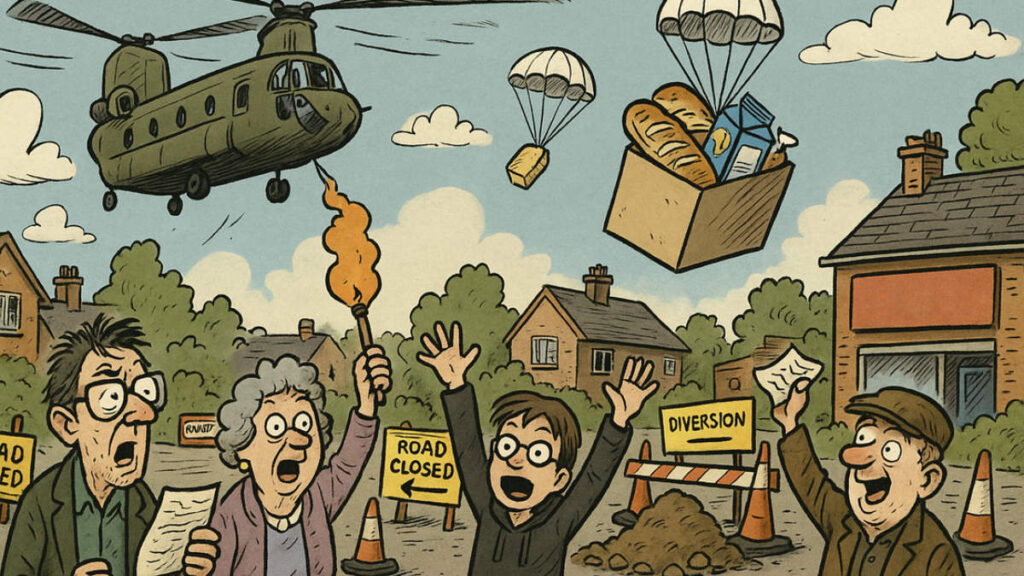
On the 4th, after sitting through enough signal cycles to reconsider her mortgage, a resident stepped out of her car at the temporary lights on Hall Road and asked the on-site lady how long the red would hold.
“They have a permit,” she later reported. “They can hold it on red as long as they like.”
Which is a spectacular amount of power to hand to three bulbs and a clipboard.
Not closed.
Never closed.
Just legally capable of stopping the village whenever required.
And so the junction outside the Crown became a live experiment in lawful paralysis. Windscreens glistened faintly from days of on-and-off drizzle. Wipers ticked in a quiet rhythm. A plumber in a Transit muttered something theological. Barry arrived with a tea and announced to anyone within earshot that this was “strategic stagnation.” He began sketching traffic flow diagrams on the back of a Tesco receipt that no one had requested.
Colin the Ferret stood beneath the signal head, cone crown damp at the edges, staring up at the red lens like a creature attempting to out-stare infrastructure.
The light did not blink.
By the 6th, the road itself began to show signs of discomfort.
Near Pledgdon Hall, water gathered across the tarmac, not dramatically, just steadily, enough to require attention. Outside Hall Farm Stables, the pothole stopped pretending to be incidental and embraced significance. It deepened. It broadened. It held water in its centre like a quiet inland lake.
A hatchback approached with confidence and left with humility.
Mick Sturbes examined it and declared, “That’s not damage. That’s development.”
Sara’s dogs inspected the rim and withdrew with caution normally reserved for hedgehogs and tax returns.
Underground, the tunnels registered the change before most residents did.
Tom, pushing north beneath the Rec, felt the clay grow heavier. Not collapse-heavy, just weighted. Lake Minor, the drainage sump carved along the left flank, required more frequent bailing. The WI’s Subterranean Catering Initiative adjusted the rota and lowered sponge by rope with solemn efficiency. One volunteer described it as “structural morale.”
Dick, driving laterally toward Takeley, struck clay so stubborn it felt personal. Tools bent. Language tightened. After a quiet consultation with Ben Dover of B.O.R.E., who denies involvement but somehow always appears when the soil behaves strangely, the team pivoted west. Two degrees. Just enough to demonstrate defiance.
Harry, ambitious toward Henham, began to collect a steady drip along his lower wall. It was christened “the metronome” and now ticks with quiet insistence. Nobody admits it, but the rhythm is oddly comforting.
On the 7th, Stansted Brook went under an official flood warning. The brook had already been broadening, fed by days of intermittent rain that never quite left. It pressed closer to its banks with polite determination. Sara’s pigeons flew low reconnaissance arcs as though water levels were a matter of aerial interest.
Margaret pinned the flood alert to her corkboard and drew a new string between “Permitted Red” and “Hydrological Assertion.” The board is beginning to resemble a railway map drawn by someone who distrusts trains.
Then, on the 8th, gravity contributed.
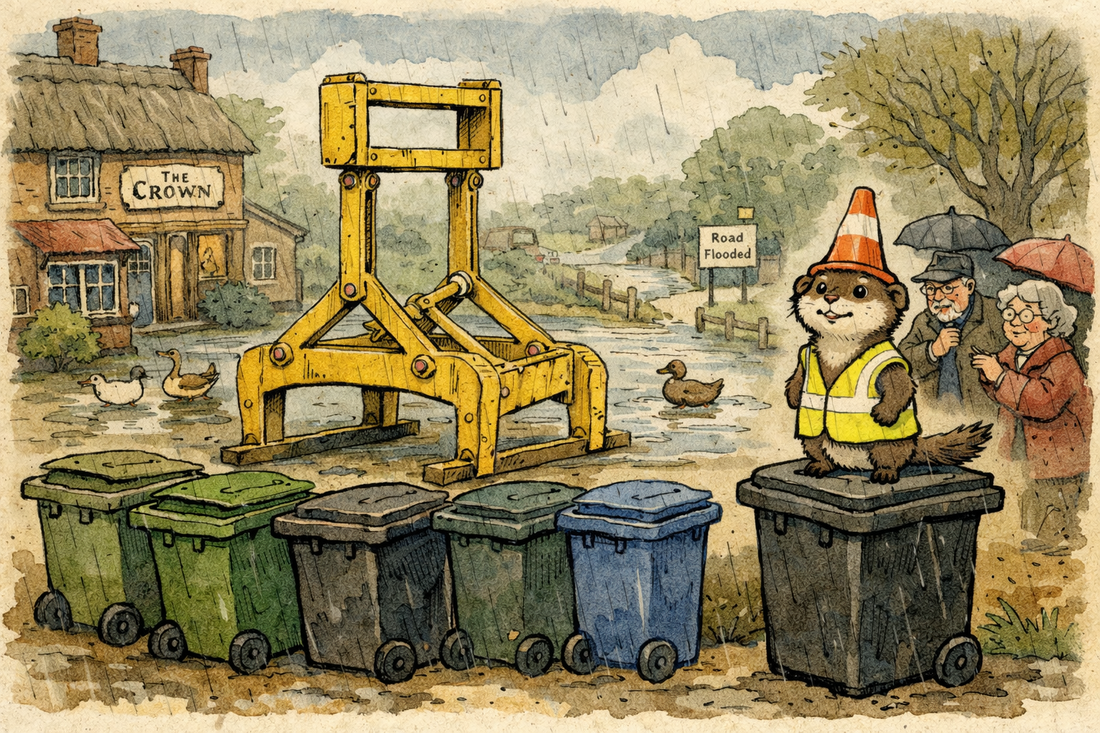
At the corner of Elsenham Gardens and New Road, a truck-mounted crane shed its brick grab attachment — the full yellow steel claw used to lift pallets of bricks. It landed in the carriageway with the thud of industrial indifference and remained there as it had always belonged.
A resident attempted to move it. The grab refused.
Barry described it as “symbolic of load fatigue.” Colin climbed onto it and stood tall, surveying the street like a monarch reviewing minor territories. For ten glorious minutes, Elsenham had a ruler, and he was wearing a cone.
Sue Veillance’s curtains parted exactly enough to confirm scale.
The grab sat in place for hours, rainwater collecting in its joints, looking less like machinery and more like a retired siege weapon.
By the 15th, Thaxted Road by Pledgdon Barns had accepted enough water to warrant genuine caution. Drivers approached slowly, testing depth with sticks and optimism. One reversed decisively and told no one.
Below ground, Harry’s seepage intensified. Sandbags appeared. A bucket chain formed. Tom widened his drainage channel. Dick reinforced a brace using what may once have been part of an allotment fence.
No panic. Just adaptation.
Then came the 19th.
Late afternoon. A single, deep thud rolled across the village.
Not cinematic. Not fiery. Just concussive enough to rearrange the air.
Glasses trembled in the Crown. A fork paused mid-descent. Dogs barked. Phones lit up.
“Anyone hear that explosion sound??”
Yes.
Joe at the crossing confirmed, “Heard it,” in the calm register of a man who will not speculate.
Underground, lanterns swung. Clay dust fell lightly from Dick’s ceiling. The metronome in Harry paused for half a beat. Tom’s support beam creaked once, then settled.
Five seconds of held breath.
Then nothing.
No smoke. No sirens. No crater. Just the sense that something somewhere had tested the village’s patience and retreated.
The brick grab was collected the following morning by a recovery vehicle whose operator declined all metaphor.
And then, on the 20th, the bins faltered.
Vehicle breakdown. Six roads missed: Robin Hood Road, Saunders Close, Mill Close, Rush Lane, Oak Drive, Maple Close. Collection Tuesday. Bins to be presented at 7 am.
It is remarkable how much emotional weight a wheelie bin can carry.
They lined the kerbs in neat formation, lids trembling faintly in the breeze. A gull inspected the situation with professional interest. Barry called it “refuse logistics instability.” The WI offered a contingency flapjack.
Colin climbed onto one of the uncollected bins and surveyed the street, the cone crown faintly illuminated by reflected streetlight.
Above him, the traffic lights continued exercising their permitted authority.
Beyond him, the brook held its broadened stance.
Below him, three tunnels pressed forward through damp clay with sponge, timber and stubbornness.
Tom steady.
Dick angled.
Harry is dripping but determined.
February did not collapse Elsenham.
It nudged it repeatedly, with paperwork, puddles, machinery, percussion and municipal delay.
And each time the surface hesitated, the village answered the only way it knew how:
If you cannot move across it, move under it.
End of Transmission.

Author: Martin Foskett
me