Image by: Knelstrom Media
The great May heat offensive and the pothole emergency
By Martin Foskett, Reporter
PUBLISHED:
UPDATED:
May arrived in Elsenham carrying two developments that nobody had expected to encounter at the same time. The first was sunshine. The second was optimism. Both were regarded with immediate suspicion.
After months spent staring at skies the colour of weak tea and navigating roads that resembled archaeological excavations, the great orange orb returned to Essex. It settled over the village with the confidence of a senior official arriving to inspect a project they had absolutely no intention of understanding. Day after day, the temperature climbed higher. Lawns surrendered. Garden centres emptied. Barbecue supplies vanished from Tesco shelves at an alarming rate. Residents emerged from their homes, blinking in the brightness like prisoners released after a long sentence, unsure whether they should be pleased or prepare for consequences.
Nobody embraced the new conditions quite like Barry, who promptly relocated his daily biscuit briefings to the chilled drinks section of Tesco and declared the area a designated cooling centre. Standing between bottled water and discounted sandwiches, he spent much of the month delivering increasingly elaborate operational updates to shoppers who had only popped in for milk. Nearby, Mark Price, the long-suffering guardian of the Meal Deal Equilibrium, maintained that everything remained fully under control despite evidence suggesting that half the village had begun panic-buying ice lollies as though preparing for a siege.
The unusual weather coincided with the local elections, creating the sort of administrative turbulence that Elsenham traditionally treats as a spectator sport. Campaign leaflets appeared through letterboxes with such frequency that several residents became convinced they were reproducing naturally. Posters emerged in windows. Debates erupted online. Entire friendships found themselves briefly under pressure over matters nobody could accurately explain by the following morning.
At Central Operations Command, operating as usual from its strategic headquarters somewhere between the bar and the dartboard at the Crown, Chairman Will N. Power attempted to monitor developments. Maps appeared. Tea appeared. Scotch eggs were distributed. Margaret established a temporary intelligence desk and spent several evenings cross-referencing election results with rainfall data, road closure schedules and a photograph of an unusually shaped cloud she had been studying since 2023. Nobody entirely understood her conclusions, although several members of the committee agreed they were probably important.
As the political dust settled and Essex found itself under new management, the defining intelligence report of the month emerged from an entirely different source.
Eagle-eyed observer Jason Hammers Starbuck had posted what appeared at first glance to be a harmless observation.
“It’s been so hot in the UK today that the tarmac is melting, and some of the potholes are actually mending themselves.”
In a normal community, this would have been recognised as a joke.
Unfortunately, Elsenham has not qualified as a normal community for many years.
Within minutes, villagers were conducting independent investigations. Drivers slowed down to inspect road surfaces. Pedestrians stopped to photograph suspiciously smooth sections of pavement. One resident reportedly spent the better part of an afternoon studying a pothole near Station Road while taking notes in a pocket notebook. At the allotments, Mick Sturbes announced that worm morale had improved significantly and suggested the warmer conditions were encouraging positive subterranean developments. Margaret pinned Jason’s observation to her evidence board and immediately connected it to seven unrelated incidents, including a burst water main from eighteen months earlier.
Even Colin the Ferret appeared interested.
Witnesses observed him standing beside a damaged stretch of road near Ambrose Corner, staring at it with the expression of a veteran commander revisiting an old battlefield. Infrastructure has always been a personal matter for Colin. He distrusts roads, pavements, timetables, and anything that arrives with an official completion date. The possibility that potholes might begin healing themselves seemed to offend him on a philosophical level.
What happened next elevated the entire situation from village folklore into county-level theatre.
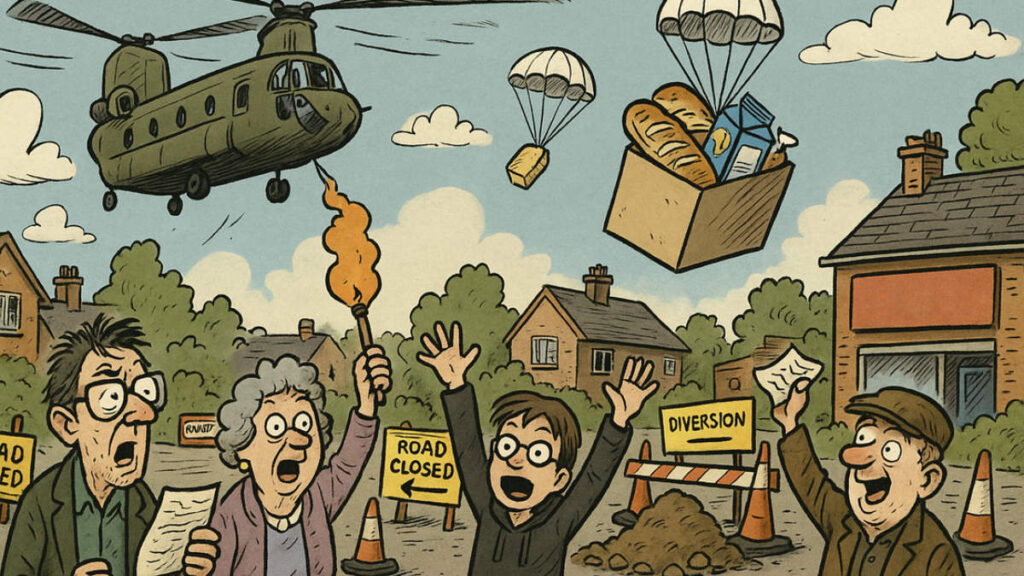
The new Leader of Essex County Council announced what rapidly became known throughout Elsenham as the Pothole State of Emergency.
Roads and pavements would become a top priority. Residents had spoken clearly. Highway maintenance had emerged as the single greatest concern across Essex. Action plans would be drawn up. Resources would be allocated. Repairs would be accelerated.
Across most of Essex, this was regarded as a serious policy announcement.
Across Elsenham, it was interpreted as a declaration of war.
For years, potholes had occupied a strange place in local life. They were too large to ignore yet too familiar to inspire genuine outrage. People learned their locations and adjusted accordingly. Some had become landmarks. Others had developed personalities. One near Henham had allegedly survived three separate repair attempts and was spoken about with a level of respect normally reserved for retired military officers.
Now, suddenly, they had become the primary target of a county-wide campaign.
At the Crown, Barry unveiled a hand-drawn map titled “Operation Smooth Surface.” Gordon adjusted his traffic-cone cravat. Sheila opened the six-ring binder reserved for constitutional emergencies. Margaret began updating threat assessments. Will N. Power delivered a speech urging calm while simultaneously ordering more biscuits.
Only Colin remained unconvinced.
Several villagers reported seeing him inspect a newly repaired section of pavement before walking away, shaking his head.
Experience had taught him not to trust promises involving roads.
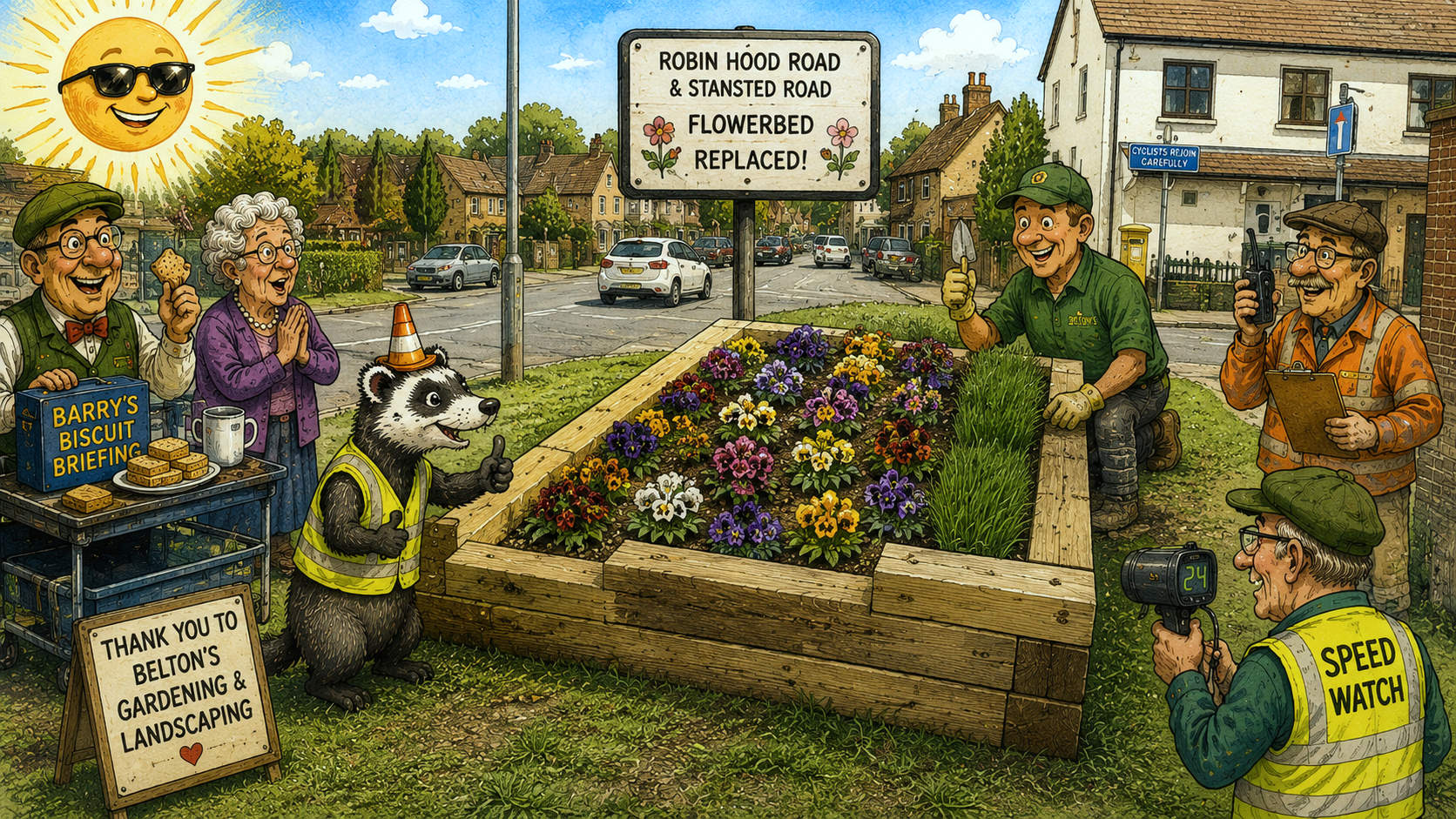
The month continued in this atmosphere of heat, hope and mild confusion until attention shifted towards a landmark that had quietly occupied the corner of Robin Hood Road and Stansted Road for more than a decade.
The flowerbed.
For over twelve years, it had stood at its post, witnessing traffic, weather, roadworks, election campaigns and the gradual collapse of countless village plans. It had survived winters, heatwaves, and several periods when nobody could remember who was technically responsible for maintaining it.
Time, however, catches up with everything eventually, and residents had begun to notice that the old structure was finally showing signs of wear.
The decision was made.
Replacement would be necessary.
Belton’s Gardening and Landscaping arrived with the calm professionalism of a specialist reconstruction team. Work commenced. Residents gathered. Opinions were exchanged. Historical comparisons were made.
One villager claimed the original flowerbed had reached its peak during the summer of 2017.
Another disagreed and cited evidence.
The debate continued for nearly forty minutes.
By the time the replacement was completed, the entire operation had acquired the atmosphere of a state occasion. People paused to inspect the finished work. Photographs circulated online. Positive reviews appeared almost immediately.
The new flowerbed looked magnificent.
Margaret described it as a stabilising influence.
Barry claimed it represented a strategic investment in floral resilience.
Mick Sturbes praised the soil structure.
Colin ignored it completely.
Meanwhile, beneath the village, the tunnels continued.
Of course they did.
The tunnels always continue.
Tom, the most reliable of the three routes, had reportedly made further progress towards Stansted. Supply movements remained steady. Morale was considered high. Barry had installed additional lighting and was already discussing commemorative plaques.
Dick, meanwhile, continued its determined push toward Takeley despite encountering fresh complications involving clay, tree roots and what one volunteer described as “ground that simply didn’t want to cooperate”. Sara had organised regular supply drops using her increasingly professional animal logistics division. At the same time, Ben Dover from the Bureau of Operational Route Excavation maintained that he knew absolutely nothing about any tunnel network despite somehow possessing detailed maps of all three routes.
Harry remained Harry.
Nobody fully understood Harry.
Nobody trusted Harry.
Yet somehow, Harry continued to advance toward Henham, generating fresh incidents almost weekly. Rumours circulated that a badger had established temporary control over one section. Other reports suggested the tunnel had briefly surfaced beneath a compost heap before disappearing again. Colin refused to discuss Harry altogether, which many interpreted as confirmation that something deeply unusual was happening.
As if all this wasn’t enough, the village was suddenly shaken by two loud bangs.
The first arrived shortly after dusk.
The second followed moments later.
Within minutes, Elsenham entered a familiar state of collective overreaction.
WhatsApp groups are activated instantly.
Curtains twitched.
Neighbourhood surveillance networks sprang into action.
Theories emerged with astonishing speed.
Gas explosion.
Military exercise.
Tunnel collapse.
Meteor strike.
Secret roadworks.
A highly aggressive wheelie bin.
Sue Veillance’s information network became so active that several residents received conflicting explanations before the second bang had even finished echoing.
By the time Central Operations Command convened an emergency meeting, speculation had reached extraordinary levels. Maps were being consulted. Timelines were being assembled. Barry had begun drafting an official statement.
The truth, when it finally emerged, proved almost embarrassingly mundane.
Kids.
Fireworks.
That was it.
Entire conspiracy theories collapsed instantly. Hours of investigation became redundant. Barry’s emergency briefing had to be revised halfway through delivery. Margaret quietly removed three pieces of string from her evidence board.
Normality, such as it exists in Elsenham, resumed.
Attention then shifted toward the railway front, where Joe delivered one of his calm operational bulletins from the crossing.
Good afternoon, Elsenham and Henham folk.
There was, he explained, a significant service disruption caused by a points failure in the Cheshunt area.
Passengers were advised to check before travelling.
Joe delivered this information with the same relaxed tone one might use to discuss cloud cover.
Around him, commuters reacted as though civilisation itself had suffered a technical fault.
Apps were refreshed repeatedly. Travel plans collapsed. Replacement journeys appeared and disappeared. One resident reportedly checked the Greater Anglia website so often that Sara’s pigeons became concerned about his welfare.
Joe remained entirely unflustered throughout.
Years at the crossing have given him the emotional range of a BBC shipping forecast.
While trains struggled elsewhere, another familiar operation was unfolding on the roads.
Community Speed Watch had returned.
Ray Darr and his volunteers emerged once again armed with clipboards, radar equipment and expressions suggesting they had personally declared war on unnecessary acceleration. High-visibility jackets appeared at strategic locations throughout the village. Drivers noticed them. Brake pedals were suddenly rediscovered.
The inevitable discussion about Waze followed almost immediately.
Would motorists be warned?
Almost certainly.
Did anyone particularly care?
Not really.
The objective was simple. If drivers slowed down, even briefly, then the operation had value.
Residents reported noticeable improvements. Several vehicles entered the village at speeds generally associated with common sense. One elderly observer described the experience as deeply unsettling.
PCSO Barry Caid monitored proceedings with timestamped precision, recording observations with the dedication of a man who genuinely enjoys functional pens.
And so May draws to a close.
The great orange orb remains overhead.
The new administration has arrived.
The potholes are under pressure.
The flowerbed has been reborn.
The fireworks mystery has been solved.
The trains remain unpredictable.
The tunnels remain active.
Community Speed Watch remains vigilant.
And somewhere near Ambrose Corner, Colin the Ferret sits atop a traffic cone studying the horizon with the expression of a commander who has survived too many campaigns to trust good news.
Because in Elsenham, every victory feels temporary. Roads improve. Pavements recover. Flowerbeds flourish. Politicians make promises. Yet everyone understands that somewhere, right now, somebody is laminating a diversion notice, planning a consultation, scheduling a closure or preparing a meeting agenda capable of generating six months of future folklore.
The Siege, as always, continues.
End of Transmission.

Author: Martin Foskett
me